

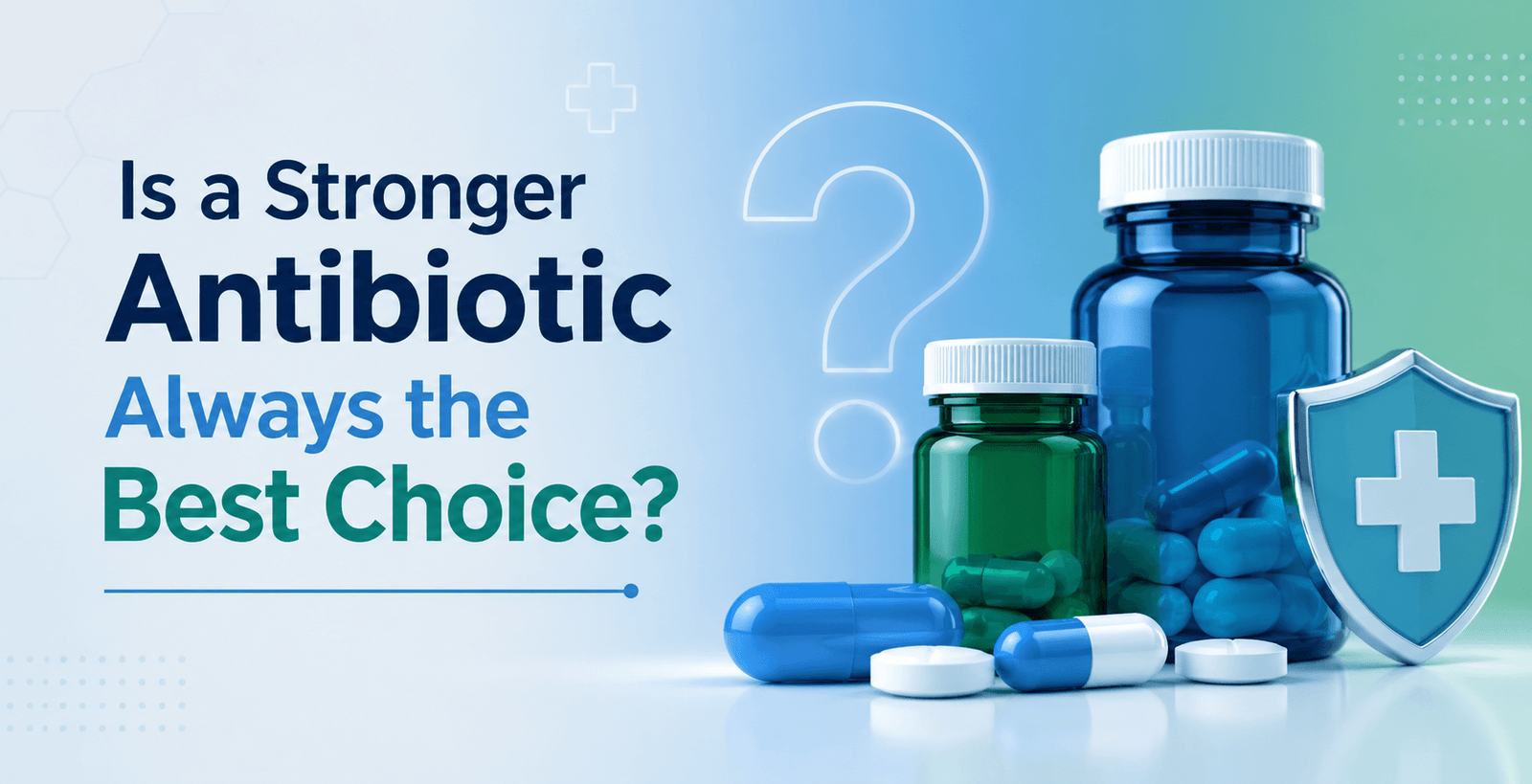
Is a Stronger Antibiotic Always the Best Choice?
Written By - Tarian Voss
on August 10, 2026
You’ve probably said it yourself at some point: “Doc, just give me the strong stuff.” It sounds logical, doesn’t it? If you have a headache, you reach for the painkiller that works hardest. Hence when there is stubborn infection level intake of antibiotics is needed. Here’s the twist — medicine doesn’t work like a video game where you unlock more powerful weapons. Stronger Antibiotic aren’t ranked on a simple scale from “weak” to “mighty.” They’re more like keys, each one cut to fit a specific lock. The strongest key in the world won’t open your front door if it’s cut for your neighbours’. And that mismatched key can leave scratches on your lock in the process.
This misconception matters more than ever. The World Health Organization estimates that bacterial antimicrobial resistance was associated with roughly 4.7 million deaths globally in 2021, and projections suggest nearly 39 million people could die from resistant infections between 2025 and 2050. A big driver of that crisis? Reaching for broad, heavy-hitting antibiotics when a precise, targeted option would have done the job beautifully. So, let’s unpack why “stronger” isn’t a real thing in antibiotic land, how your doctor actually chooses your prescription, and what smart habits keep you and your family safe.
Why “Stronger” Doesn’t Always Mean Better ?
Let’s retire the word “stronger” right now, because it’s the root of the whole misunderstanding. When pharmacists and doctors talk about antibiotics, they don’t use a power rating — they talk about spectrum and fit. Spectrum simply means the range of bacteria a drug can act against. A narrow-spectrum antibiotic targets a small, specific group of bacteria, while a broad-spectrum one attacks many different types at once. Neither is inherently “better.” They’re tools designed for different jobs, and effectiveness is measured by whether the drug kills your bacteria, not how many other bacteria it could theoretically take down along the way.
Think of it like pest control. If you have termites in one wall, the best exterminator uses a targeted treatment on that wall — not one that fumigates your entire neighbourhood. Broad-spectrum drugs are sometimes described by patients as stronger antibiotics, but what they really are is wider. That width comes with collateral damage, which we’ll get into shortly. Meanwhile, an old, humble, narrow-spectrum drug like penicillin can still be a perfect bullseye for the right infection, decades after it was discovered.
The matching principle is what clinicians call targeted antibiotic therapy: identify the bug (or make an educated, evidence-based guess), then pick the narrowest drug that reliably kills it. This approach clears your infection while sparing the trillions of helpful bacteria living in your gut, on your skin, and throughout your body.
Now for the myths.
Myth one: “If one antibiotic didn’t work, I need a stronger one.” Usually, the real issue is a wrong diagnosis (many infections are viral, and no antibiotic touches a virus), a drug that doesn’t penetrate the infection site well, or simply not enough time.
Myth two: “Broad-spectrum means faster.” Not necessarily — speed depends on getting the right drug to the right place at the right dose.
Myth three: “Newer equals better.” Some of the oldest antibiotics remain first-line treatments precisely because bacteria haven’t outsmarted them. Once you see antibiotics as keys rather than hammers, the whole question of “stronger” dissolves — and you’re asking the question that actually matters: is this the right one?
How Doctors Match Antibiotics to Specific Bacteria ?
When a clinician writes your prescription, it might look like a ten-second decision. In reality, there’s a quiet, layered process happening behind it — and understanding it helps you trust (and complete) your treatment instead of second-guessing it halfway through.
First comes your medical history. Did you take any antibiotic recently? Do you have allergies — especially to penicillin? Are you pregnant, breastfeeding, managing kidney or liver conditions, or taking other medications that could interact? Your age matters too; some antibiotics aren’t suitable for children or need dose adjustments in older adults. This is why answering your doctor’s questions honestly, even the boring ones, genuinely shapes the quality of your prescription.
Next is the infection’s location. Antibiotics don’t distribute evenly through your body. concentrate in urine, making them ideal for bladder infections but useless for pneumonia. A drug that’s perfect for a skin abscess might never reach therapeutic levels in your middle ear. So, the “best” antibiotic for one body part can be the wrong choice for another — even against the same bacterium.
Then there’s laboratory testing, the closest thing medicine has to a crystal ball. When doctors suspect a bacterial infection, they may take a culture — a swab, urine sample, or blood draw — and grow the bacteria in a lab. Once the organism is identified, technicians perform susceptibility testing: literally exposing your bacteria to panels of antibiotics to see which ones stop it. This turns an educated guess into targeted antibiotic therapy with real evidence behind it. Rapid molecular tests are making this faster every year, sometimes delivering answers in hours rather than days.
Finally, your doctor weighs local resistance patterns. Bacteria in your community have their own resistance profiles, tracked through surveillance data. A urinary tract infection drug that works 95% of the time in one region may fail 40% of the time in another because the local E. coli population has evolved differently. Prescribers consult hospital antibiograms and regional guidelines — like those in the CDC’s stewardship framework — to choose empiric treatment that’s likely to work where you live. Put together, these four factors mean your prescription is essentially personalized medicine. And it’s exactly why borrowing someone else’s “stronger” antibiotic, prescribed for their body, their infection, and their region, is such a losing gamble.
Hidden Risks of Using Broad-Spectrum Antibiotics Too Often
Broad-spectrum antibiotics absolutely save lives — when someone is critically ill and doctors can’t wait for culture results, that wide net is exactly what’s needed. The problem arises when the wide net becomes the default for everyday infections. Overusing these drugs carries costs you won’t feel on day one, but they accumulate quietly, both in your body and in the wider world.
Start with your gut microbiome — the sprawling community of trillions of bacteria in your intestines that help digest food, produce vitamins, train your immune system, and even influence your mood. Broad-spectrum antibiotics can’t distinguish between the invading pathogen and these friendly residents, so they mow down both. The result is what scientists call dysbiosis: a disrupted microbial ecosystem that can take weeks to months to recover. You may face with some minor issues such as bloating and diarrhoea. More seriously, a depleted gut opens the door for opportunists like Clostridioides difficile, a bacterium that causes severe, sometimes life-threatening colon inflammation — and C. diff infections are strongly linked to prior broad-spectrum antibiotic exposure.
Then there’s the bigger, scarier risk: breeding resistant bacteria. Every time bacteria encounter an antibiotic, the survivors — the ones with lucky mutations — multiply and pass on their resistance genes. Broad-spectrum drugs apply this evolutionary pressure across many bacterial species at once, not just the one causing your sore throat. It’s like running a resistance-training gym for the entire bacterial population in your body. The collective result is the global crisis making headlines: the WHO has warned that the pipeline of new drugs to fight superbugs is “worryingly thin,” meaning we’re creating resistant bacteria faster than we’re inventing weapons against them.
Finally, side effects scale with spectrum. Broader drugs often come with more disruption: higher rates of antibiotic-associated diarrhoea, yeast infections, nausea, and in some classes, specific risks like tendon problems or sun sensitivity. None of this means you should fear a broad-spectrum prescription when it’s genuinely indicated — sometimes it’s the right call, and your doctor will tell you when. That choice isn’t a downgrade. It’s precision — protecting your future self and everyone else’s.
Conditions That Often Respond to Narrow-Spectrum Treatment
Here’s the part that surprises most people: many of the most common bacterial infections families face every year respond perfectly well to narrow, targeted antibiotics — sometimes drugs that have been around since your grandparents’ era. Let’s walk through the greatest hits.
Strep throat is the poster child. Streptococcus pyogenes, the bacterium behind it, remains exquisitely sensitive to plain penicillin and amoxicillin. Decades of use haven’t dulled its effectiveness, and guidelines worldwide still name these narrow drugs as first-line treatment. No escalation needed, no wider net required — just the right key for a very cooperative lock.
Certain skin infections follow a similar pattern. Uncomplicated cellulitis and impetigo are usually caused by streptococci or methicillin-sensitive staphylococci, and they typically respond to narrow agents that specifically target these gram-positive bacteria. You need to save the stronger antibiotics for cases which involves resistant bacteria. Your physician will determine whether MRSA is one of the concerns by checking the infection.
Selected urinary tract infections are another everyday example. Uncomplicated UTIs in otherwise healthy people are usually caused by E. coli, and treatment guidelines emphasize choosing agents based on local susceptibility data, favouring narrow options that concentrate in the urinary tract while leaving the rest of your body’s bacteria largely alone. This is one area where resistance patterns vary dramatically by region, which is why your doctor’s knowledge of local data — not the drug’s reputation — drives the choice.
Beyond these, other targeted bacterial infections where clinically appropriate include whooping cough, certain dental infections, syphilis, and many ear infections, all of which have established narrow-spectrum first-line treatments backed by decades of evidence. Research into outpatient pneumonia treatment shows a similar trend: guidelines recommend narrow-spectrum regimens for otherwise healthy patients, reserving broad coverage for those with significant comorbidities.
The pattern should be clear by now: when the culprit is known or strongly suspected, precision wins. You recover just as fast — often with fewer side effects and less gut disruption — and you haven’t contributed to the resistance problem.
Protecting Your Gut Health With Antibiotics
Even the most perfectly targeted antibiotic will ruffle some feathers in your digestive tract — that’s normal, and manageable. With some very important habits you can support through the treatment and bounce back once again. None of this is complicated, but it does reward a little consistency.
Healthy eating is your foundation. During a course of antibiotics, favour gentle, fibre-rich whole foods: oats, bananas, cooked vegetables, lentils, and plain rice. Fiber feeds your beneficial gut bacteria, giving the survivors something to work with as they rebuild. Fermented foods like plain yogurt with live cultures, kefir, and traditionally fermented vegetables can help reintroduce friendly microbes — though it’s wise to space them a couple of hours away from your antibiotic dose so the drug doesn’t immediately kill what you just ate. Go easy on heavy grease, excess sugar, and alcohol, all of which stress a digestive system that’s already doing repair work. And if your antibiotic interacts with dairy (some do — check your leaflet or ask your pharmacist), follow those timing instructions carefully rather than skipping them.
Hydration deserves more credit than it gets. Adequate water intake helps your kidneys process and clear the medication, supports the mucosal lining of your gut, and eases the loose-stool side effects some antibiotics cause. If you’re experiencing diarrhoea, you’re losing fluids and electrolytes faster than usual, so bump up your intake — water, diluted oral rehydration solutions, and clear broths all count. A simple rule: if your urine is pale yellow, you’re doing fine.
Discussing probiotics with a healthcare professional is a smart move, especially if you’ve had antibiotic-associated digestive trouble before. Some clinical evidence suggests certain probiotic strains, taken during and after antibiotic treatment, may reduce the risk of antibiotic-associated diarrhoea and C. diff infection in higher-risk patients. But “probiotic” is a huge category with varying quality and evidence, so ask your pharmacist or doctor which strains and doses make sense for you rather than grabbing the prettiest bottle.
For recovery, give your body grace. Finish your full course as prescribed, eat well for a few weeks afterward, prioritize sleep, and don’t panic if your digestion feels slightly off for a little while — rebuilding a microbiome is a renovation, not a light switch. If diarrhoea becomes severe, bloody, or persistent, that’s your cue to contact your doctor promptly rather than waiting it out.
Some Smart Antibiotic Habits
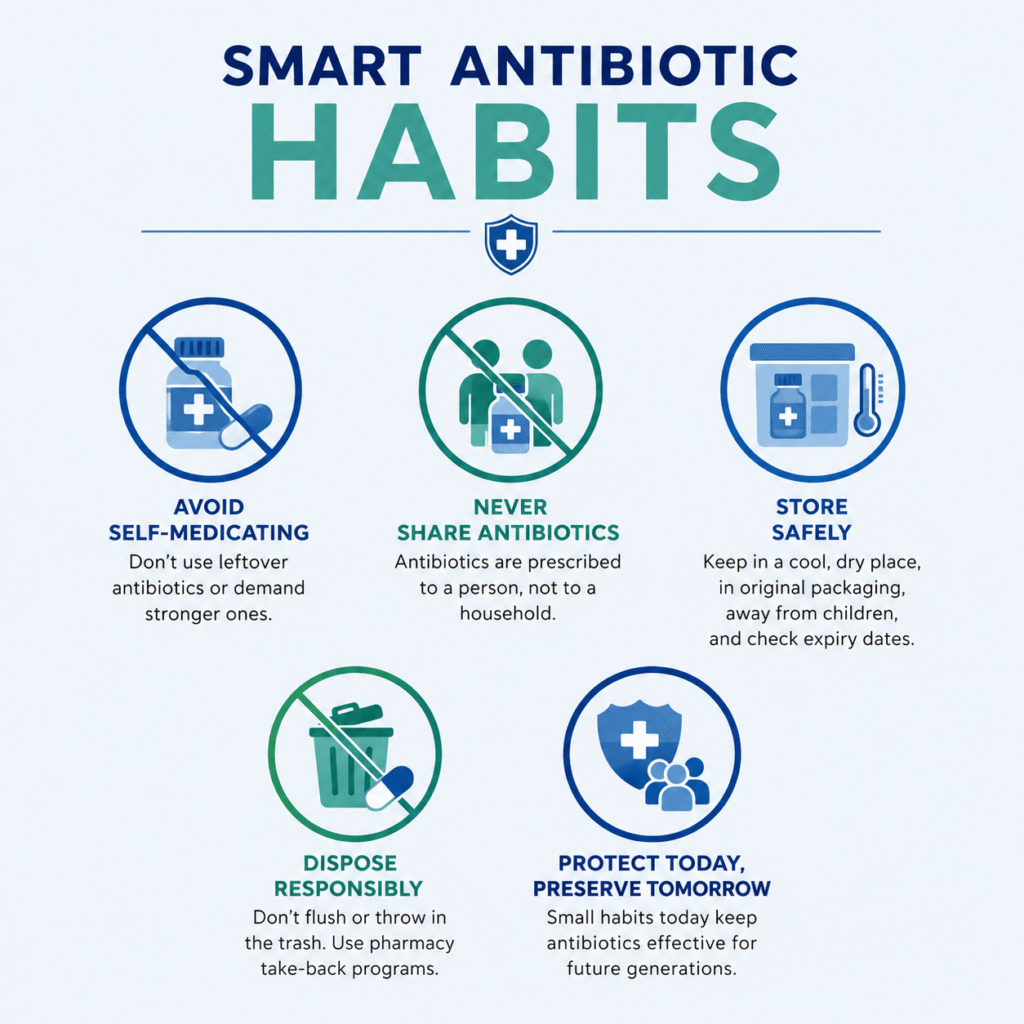
Antibiotic stewardship sounds like something that happens in hospitals and government agencies — and it does — but honestly, the frontline of this effort is your kitchen counter and medicine cabinet. A few household habits make an outsized difference.
Avoid self-medicating, full stop. That leftover half-course from last winter is not a match for today’s symptoms. You don’t know whether your current illness is bacterial (it very well might be viral, in which case antibiotics do nothing but harm), you don’t know the right drug or dose, and a partial supply almost guarantees an incomplete course — the perfect recipe for breeding resistant bacteria. The same logic applies to demanding stronger antibiotics at the clinic: instead of asking for power, ask your doctor why they chose what they chose. Most will happily explain, and you’ll walk out genuinely informed.
Never share antibiotics. This one’s tempting — your partner has “the same thing,” so why not split the pills? Because their infection may be different, their medical history is different, their allergies are different, and splitting means neither of you completes a proper course. Antibiotics are prescribed to a person, not to a household.
Store medicines safely: in a cool, dry place (bathrooms are actually terrible — steam and humidity degrade medications), in original packaging with the label intact, and always out of children’s reach. Check expiry dates periodically, because a degraded antibiotic isn’t just ineffective — underdosing yourself with a weakened drug encourages resistance.
Dispose of unused antibiotics responsibly. Don’t flush them or toss them loose in the trash, where they leach into waterways and soil — environmental antibiotic residue is itself a driver of resistance. Most pharmacies run take-back programs; in many communities, periodic drug take-back events will accept them too. Ask your pharmacist where yours should go.
These habits might feel small, but multiplied across millions of households, they’re how societies keep antibiotics working for the next generation. Your future self — and your kids — will thank you.
Frequently Asked Questions (FAQs)
Is a “stronger” antibiotic always the better choice?
Not at all. We tend to think of medicine like power levels, but antibiotics don’t work that way. It isn’t about finding the absolute strongest drug on the shelf—it’s about finding the exact match for the specific bug causing your trouble. Honestly, an older, simple antibiotic made for your exact infection is almost always the smarter, safer pick.
What does broad-spectrum versus narrow-spectrum actually mean?
Imagine broad-spectrum antibiotics as a wide net cast over your body’s ecosystem—they wipe out a huge variety of bacteria all at once. Narrow-spectrum antibiotics are more like a targeted laser beam. If your doctor knows exactly what bacterium is making you sick, the laser approach is much better because it leaves your friendly, healthy bacteria alone.
If I’m still feeling awful, shouldn’t I call my doctor for something stronger?
You should definitely check in if you aren’t improving, but don’t assume you need a heavier drug. Sometimes antibiotics take a couple of days to kick in, or you might actually be fighting a virus (which antibiotics can’t touch). Let your doctor figure out why you’re still down before switching meds.
Why am I being given old-school penicillin in this day and age?
Simply put: because it still works amazingly well. For common issues like strep throat, classic penicillin remains the top choice worldwide. The bacteria haven’t figured out how to outsmart it, and because it’s so focused, it leaves your gut biome relatively untouched.
Do these medicines wreck your immune system?
They don’t attack your immune cells directly, but broad-spectrum drugs can take a toll on your gut flora. Since a huge portion of your immune health relies on a thriving gut, knocking out those good microbes can temporarily leave you feeling a bit run down.
Should I grab some probiotics while I’m on a course?
It’s often a smart move, especially if antibiotics usually give you an upset stomach or diarrhoea. Just chat with a pharmacist to pick the right strain, and remember to space them out—take your probiotic a few hours after your antibiotic dose so the medicine doesn’t immediately wipe out the good bacteria you just took.
Is it okay to hang onto leftover pills for the next time I get sick?
Definitely not. Beyond the fact that medicine expires, a half-used bottle isn’t a full treatment. You also can’t be sure your next illness is caused by bacteria at all.
Can I stop taking them early if I feel completely back to normal?
Resist the urge! Feeling good just means the medicine has knocked the bacterial population down, not that it’s completely gone. If you quit early, the toughest, most resilient bacteria survive, multiply, and come back with a vengeance—making you sick all over again.
What’s the right way to throw away leftover medicine?
Please don’t flush them or toss them in the kitchen trash. Antibiotics that end up in landfills or waterways expose wild bacteria to low doses of medicine, creating resistant bugs in nature. Drop them off at a pharmacy take-back bin instead—they’ll dispose of them safely.
More Blogs