

Why Generic Medicines Are Changing Online Pharmacy ?
Written By - Cade Herrington
on August 17, 2026
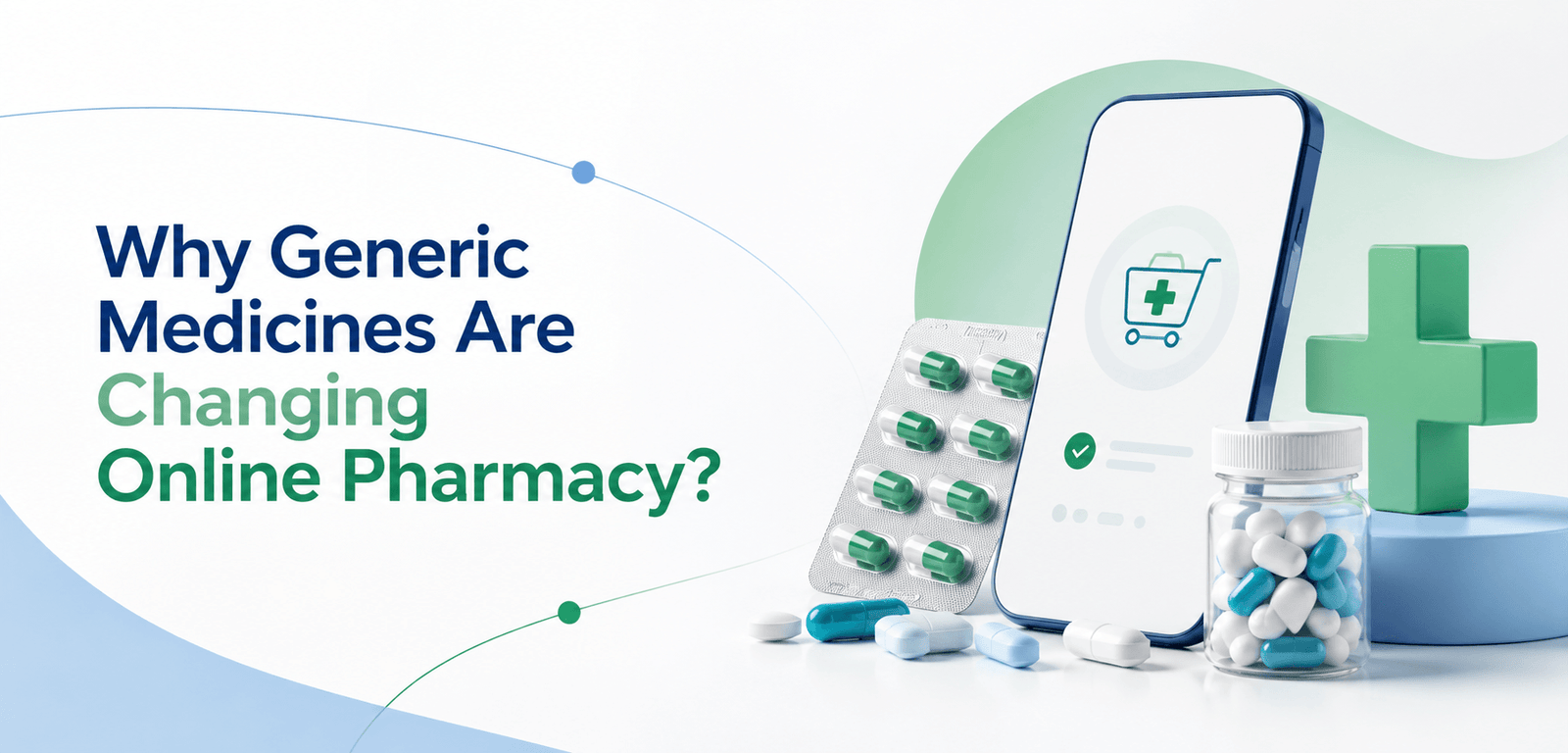
You open your medicine cabinet and reach for that familiar strip of tablets. But have you ever flipped it over and actually read what’s written in small print? Chances are, more than half the medicines you’ve ever taken were generic — you just never thought twice about it. That’s the quiet, unglamorous magic of generic medicines. These medications treat the same conditions and use the active ingredients with the fraction cost of the branded ones.
Here’s the thing: online pharmacies are changing fast, and generic medicines are sitting right at the center of that shift. You’re no longer limited to whatever your neighbourhood chemist happens to stock. You can compare, research, and order from the comfort of your home, and generics are increasingly the default choice for millions of people worldwide — not because they’re “cheap,” but because they work just as well and free up your budget for the things that actually need it.
This blog is your no-nonsense, myth-busting guide to generic medicines. You’ll learn what the word “generic” actually means (spoiler: it’s not a downgrade), how it stacks up against branded medicine, what keeps quality in check, why prices vary so much, and how you — yes, you — can make confident, informed choices the next time you’re browsing an online pharmacy. Grab a cup of tea, because by the end of this, you’ll never look at your medicine strip the same way again.
What “Generic” Actually Means (It’s Simpler Than You Think ?
Let’s clear up the biggest misconception right away: generic medicines aren’t cheap, second-rate knockoffs. A generic drug contains the exact same active ingredient, in the exact same strength and form, as the original brand-name version.
To understand why they exist, think of the original drug as an exclusive recipe. When a new medicine is invented, the companies get a patent that is the exclusive right to sell the medicine for a certain number of years. But once that patent expires, the secret is out. Other licensed manufacturers are legally permitted to make the exact same formula, minus the original company’s high price tag.
So why do the names on the box look different? It comes down to marketing. The original brand name is trademarked property, so generic makers usually label the drug using its official chemical name instead. When you see two boxes with different brand labels but the exact same active ingredient listed underneath, you’re looking at chemical twins, not distant cousins.
What surprises most people is that generics face the same strict regulatory hurdles before reaching pharmacy shelves. Authorities require generic makers to prove “bioequivalence”—a fancy scientific way of showing that the drug absorbs into your bloodstream at the exact same rate and strength as the brand-name original.
The next time someone tells you generics are a “watered-down” shortcut, you can set the record straight. They aren’t inferior; they’re just the exact same proven medicine without the fancy box and marketing markup.
Generic vs Branded Medicines: What Really Sets Them Apart ?
Next time you’re standing at the pharmacy counter, wondering if you should spring for the brand name or stick with the generic, here’s the bottom line: the active ingredient—the actual medicine that makes you feel better—is identical in both.
So, what’s actually different? Mostly the inactive stuff: binders, coatings, colors, or flavourings. These extra ingredients don’t change how the medicine works in your body. The only time they even matter is if you happen to have a rare allergy or sensitivity to a specific filler or dye, which is easy enough to check with your pharmacist.
The biggest visual difference comes down to presentation. The branded drugs are in the shiny boxes which are backed by the dollars of investment in advertising and brand recognition. Generics skip the high-end packaging and aggressive marketing entirely. That’s the real reason for the price gap: you aren’t paying less because the generic is weaker; you’re paying less because you aren’t footing the bill for a massive ad campaign.
The names can also throw people off. Marketing teams design catchy, punchy brand names that are easy to remember. Generic drugs, on the other hand, are labeled by their official chemical name. It might look like a tongue-twister on the label, but it actually tells you the exact active compound you’re getting, no matter who manufactured it.
When it comes to effectiveness, there is zero debate. Decades of research and real-world use prove generics perform just as well as brand-name drugs for most people. The choice here is not only about the quality and health outcomes however it is also whether you need to pay extra for the fancy packing or a familiar logo.
About the Quality and Regularity Standards:
We’re practically wired to think “cheaper equals worse,” especially when it comes to our health. Doubting it isn’t silly—it’s just smart. But once you pull back the curtain on how these meds are actually made, that worry usually disappears.
The truth is, generic drugs aren’t allowed anywhere near a pharmacy shelf unless they jump through the exact same legal and scientific hoops as the big-name brands. The factories making them have to follow strict rules called Good Manufacturing Practices. We’re talking relentless checks on everything from raw ingredients and clean equipment to batch testing. Inspectors show up regularly, and if a plant slacks off, they lose their license. Simple as that.
Then there’s the big test: bioequivalence. Before a generic gets approved, researchers run tests to make sure the active ingredient hits your bloodstream at the same speed and strength as the brand-name version. If it doesn’t match up within a tight, scientifically proven window? It gets tossed out.
This peace of mind matters even more if you’re ordering from an online pharmacy, where you don’t have a local pharmacist to talk to across the counter. Sticking to legitimate, licensed online sites ensures you’re getting the real deal, not a knockoff.
So, when you see a generic medicine, don’t think of it as a cheap shortcut. Think of it as the exact same recipe, made to the exact same safety standards, just without the fancy box and heavy marketing markup. You can take it knowing it’s got the science—and the law—standing right behind it.
Why Prices Can Differ So Much (It’s Not What You Think) ?
Ever noticed how the exact same generic medicine can cost five dollars at one pharmacy and twenty at another? It’s enough to make anyone suspicious. When prices bounce around like that, it’s totally natural to think, “Okay, what’s the catch here?”
The truth is, a lower price tag isn’t a sign that someone cut corners on safety—it’s just how the industry works.
The biggest reason brand-name drugs are so expensive in the first place is Research and Development. Inventing a brand-new drug from scratch takes years of lab experiments, massive clinical trials, and mountains of cash. When the original company sets their price, they’re trying to make all that money back. Generic makers skip that whole expensive gambling phase. They’re using a recipe that’s already proven to work, which slashes their overhead from day one.
Then comes the marketing budget. Big pharma spends fortunes on slick TV ads, billboards, and sales reps taking doctors out to lunch. Generic companies don’t bother with any of that. When you buy generic, you aren’t paying for a multi-million-dollar ad campaign.
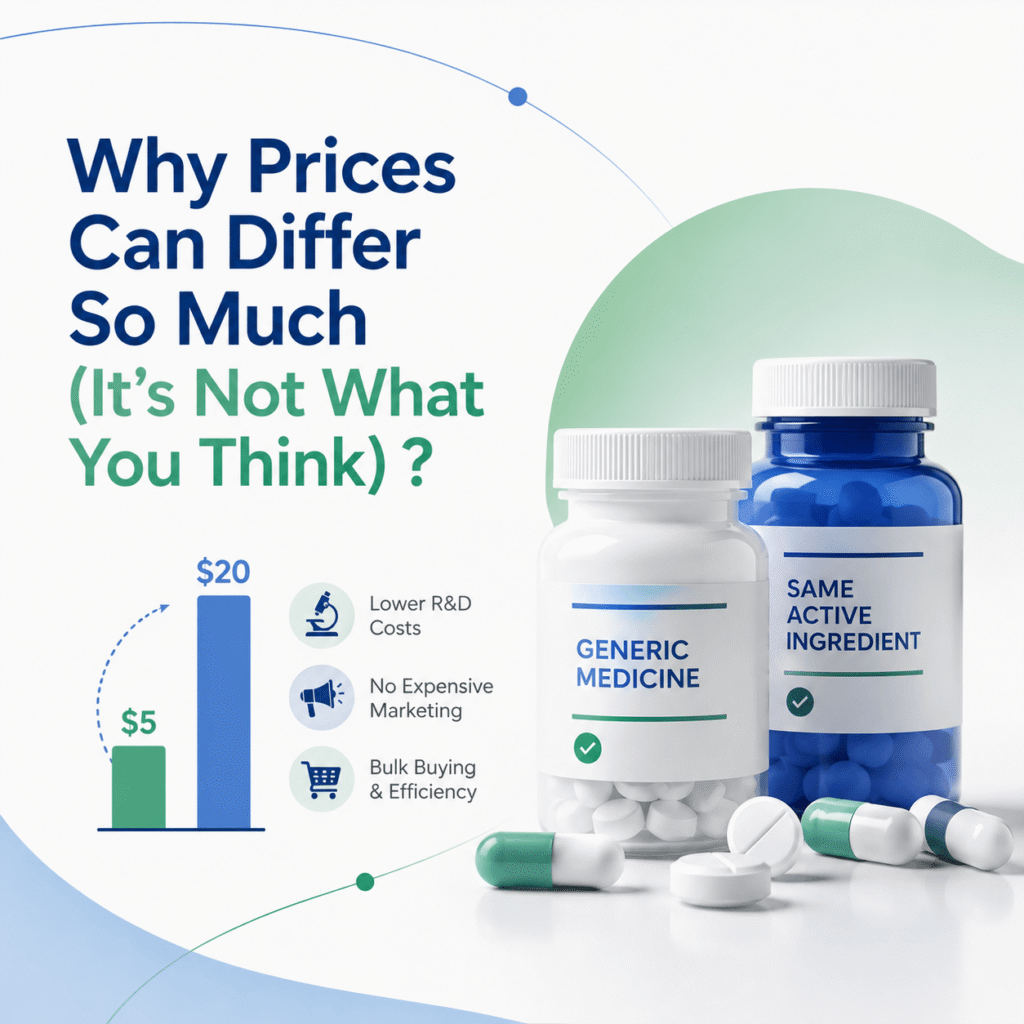
When you see price differences between two sellers carrying the exact same generic medicine, that usually comes down to simple business mechanics. Bigger companies can buy in massive bulk, and legitimate online pharmacies often cut out middleman markups to pass those savings on to you. Fluctuation in raw material costs or shipping can bump the price around a bit, too. Seeing a generic medicine priced super competitively from a licensed seller isn’t a red flag.
Common Misconceptions About Generic Medicines (Let’s Bust Them)
We’ve all heard at least one of these warnings from a well-meaning friend or relative. It usually comes from a good place, but most of it is based on outdated myths rather than actual medical facts. Let’s break down the most common ones and set the record straight once and for all.
Generic Medicines do not work as branded : Before any generic drug hits the market, it has to prove that your body absorbs the main ingredient at the exact same speed and strength as the big-name version. The medicine is the exact same—only the box and the price tag are different.
More side effects as compared to the Originals : On very rare occasions, someone might react to a specific dye or filler used to bind the pill, but that’s an individual allergy issue, not a flaw in the medicine itself.
“If it’s that cheap, someone definitely cut corners.” It feels logical to think “you get what you pay for,” but that’s just not how pharma pricing works. Generics are cheaper because the makers didn’t have to spend a fortune on lab development or TV ads—not because they used lower-grade ingredients or skipped quality checks.
Doctors prefer the branded medications : Doctors often write down brand names out of pure habit or past training. In fact, tons of doctors now intentionally write the generic chemical name instead, specifically so you can save money at the pharmacy.
Ordering generic medicines are risky: You should not buy from the unverified and unauthorized websites however it does not means the generic are bad.
How You Can Make Informed Choices (A Simple Checklist) ?
So, how do you actually take all this and put it to work the next time you’re refilling a prescription? The good news is, you don’t need to turn into a pharmacology expert overnight. It really just comes down to having a quick, simple game plan so you can get the best price without second-guessing your safety.
Here’s a practical way to handle it:
- Focus on the main ingredient, not the brand. Next time your doctor writes a prescription, ask them,
- “What’s the actual chemical name for this?” Knowing the main active ingredient gives you options instead of locking you into one expensive brand name. Ask your doctor or pharmacist about switching. If you’ve been taking a brand-name drug for years, just ask if a generic option makes sense for you. Most doctors are totally fine with it—especially for daily meds where the savings really add up over time.
- Scan the label for allergies. The main medicine in every generic is identical, but the binders or dyes can vary. If you have known sensitivities to specific fillers, a quick glance at the label is a smart habit that saves you from an unexpected reaction.
- Order from genuine sellers. Search for the online pharmacies which are clear with every information, batch details or expiration dates. If a website seems cagey about where its drugs come from, trust your gut and walk away.
- Don’t let the price tag trick you. A higher-priced generic isn’t automatically higher quality, and a super cheap one isn’t automatically sketchy. The safety credentials of the pharmacy matter way more than the number on the sticker.
- It’s just about asking a couple of smart questions and knowing what to look for—which is where GenPharmaRx comes into the picture to make things a whole lot easier.
Frequently Asked Questions
Are the generic medicines are safe as compared to the branded ?
Yes, absolutely. A generic medicine can’t legally be sold until it proves bio equivalence to the original. That’s just a scientific way of saying the active ingredient absorbs into your body at the exact same speed and strength. Your body literally can’t tell the difference.
Why is that a generic medicine looks different from the branded one?
The brands have trademarks which prevent the generic ones to copy the exact style, color and shape as the brand one. Therefore, the main chemical component is the same as branded the look, dyes and outer coatings are different.
Can I swap to a generic without talking to my doctor first?
For most routine meds, switching is completely seamless. However, it’s always a good idea to run it by your doctor or pharmacist first—especially for medications with a very narrow sweet spot for dosing, where tiny adjustments need careful monitoring.
Do the generic drugs expire faster as compared to branded ?
Generics go through the exact same stability and shelf-life tests as expensive brands. As long as you store them properly—like keeping them out of a humid bathroom—they stay potent for just as long.
If generics are supposed to be cheap, why are some still pricey?
The generic medications skip the big R&D. Some factors such as complicated manufacturing, high cost of raw materials and less competition of the niche drugs make the price higher than expected.
Is it legally advisable to buy generic medicines online?
If you are buying from genuine and clear, regulated online pharmacy which follow all healthcare laws, it is safe and legally advisable to buy the generic medicines online.
Does a generic last as long on the shelf as a branded drug?
Yes. Regulators hold generics to the exact same expiration standards. Environmental stress tests prove that a generic retains its full strength and safety right up to the expiry date printed on the box.
Can two generic versions of the same drug be different from each other?
Slightly, but only on the outside. Two different manufacturers might use different binders, colors, or shapes, but the core active ingredient doing the actual healing is.
More Blogs