

Can Your Genetics Affect How Sildenafil and Tadalafil Work?
Written By - Tarian Voss
on November 13, 2026

Can Your Genetics Affect How Sildenafil and Tadalafil Work? The Science of Personalized ED Treatment
Picture two men sitting in a clinic, both of the exact same age, holding identical prescriptions for the exact same dose of medication. One man takes his pill and reports reliable, consistent results that have completely restored his confidence. The other man takes the same medication under the same conditions and notices very little effect at all. That split experience is remarkably common in clinical practice, and it naturally raises a fair question among patients and researchers alike: could your genetics be part of the explanation behind why these drugs work brilliantly for some and barely at all for others?
The short answer is that while the research exploring genetics and erectile dysfunction medication is real, it is still very much in its early days. To understand where DNA fits into the picture, it helps to start by looking at the factors that are far better established in modern medicine. Overall health and the underlying cause of erectile dysfunction play a massive role. Erectile dysfunction can reflect underlying vascular disease, diabetes, high blood pressure, low testosterone, nerve damage, pelvic surgery, depression, performance anxiety, or a complex mix of these physical and psychological factors. A medication designed to improve blood flow response can only do so much if the primary physiological cause is severe or unmanaged.
Age is another critical variable. In healthy volunteers aged sixty-five or older, sildenafil clearance is significantly reduced, which naturally raises the overall blood levels of the drug compared with younger men taking the exact same dose. Other medications also heavily skew how your body processes these treatments. Some drugs slow down the specific liver enzymes responsible for breaking down sildenafil and tadalafil, inadvertently raising your chemical exposure. Nitrates represent an absolute medical concern; combining them with phosphodiesterase type 5 inhibitors can trigger sudden, dangerous drops in blood pressure. Liver and kidney function matter deeply as well, as both organs dictate how long these active compounds stay circulating in your body, which is why official prescribing labels consistently recommend dose caution in patients with organ impairment.
Finally, the way the medicine is taken makes all the difference. Timing, a heavy, high-fat meal before taking sildenafil, alcohol consumption, underlying performance anxiety, and a genuine lack of sexual stimulation can all derail the process. It is vital to remember that these medicines simply help the body respond to arousal; they do not create the spark out of nowhere. Genetics may eventually prove to be one more layer stacked on top of these everyday variables, but right now, it is certainly not the primary explanation for treatment success or failure.
What Is Pharmacogenetics, and Can Your DNA Influence ED Medication?
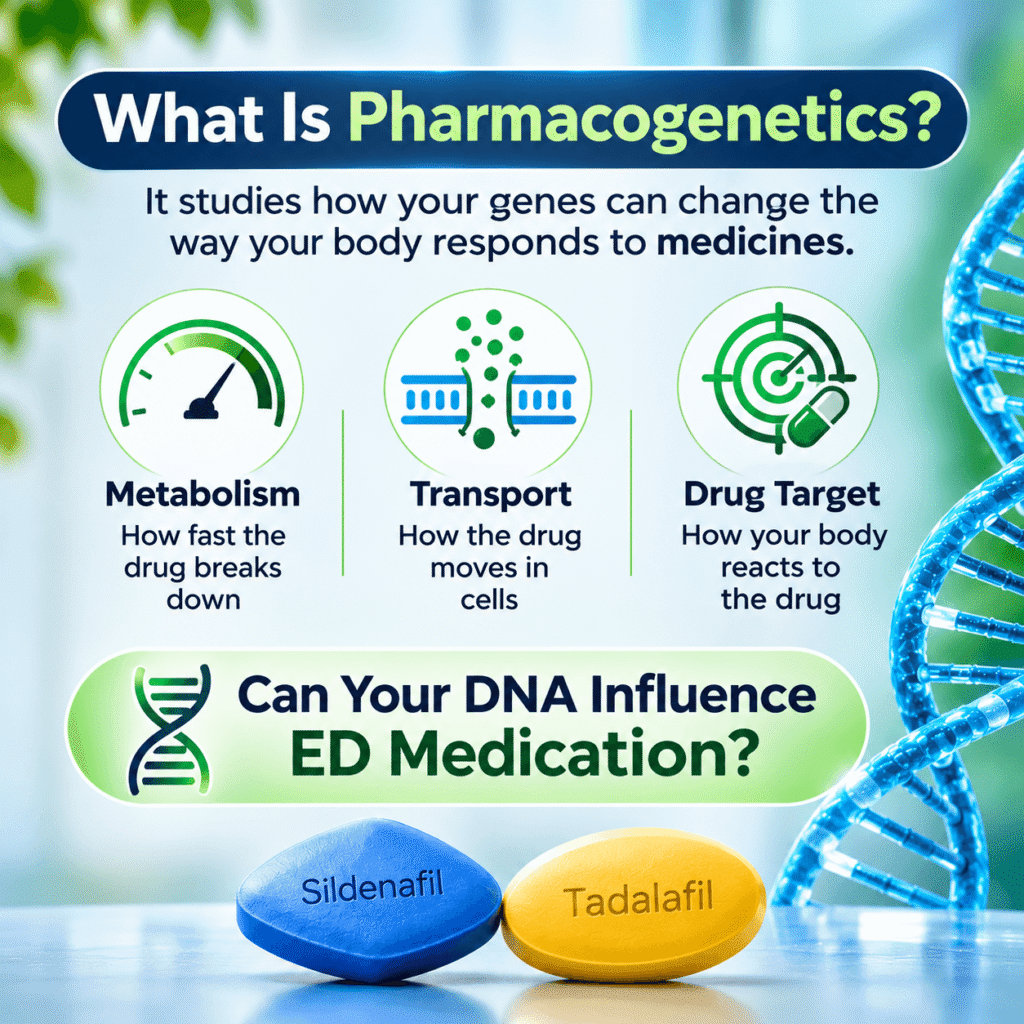
Pharmacogenetics is the fascinating study of how inherited variations in your genes affect the way your body responds to medicines. Those genetic variations can influence three primary pillars of pharmacology: metabolism, which dictates how fast specific enzymes break down a drug; transport, governing how specialized proteins move a drug in and out of cells; and drug targets and signaling pathways, which determine how your body reacts once the drug successfully reaches its cellular destination. This expanding field underpins the entire concept of personalized medicine, where medical treatment is meticulously matched to the unique biological profile of the individual rather than the statistical average patient. For certain classes of drugs, this approach already guides everyday clinical prescribing. The Clinical Pharmacogenetics Implementation Consortium publishes peer-reviewed, evidence-based gene-drug guidelines for medications where the scientific data is strong enough to act upon safely in a doctor’s office.
When it comes to erectile dysfunction medications, however, the medical picture looks quite different. A comprehensive review published in Pharmacogenomics concluded that very few studies exist in this specific niche, that most of the existing research focuses almost exclusively on sildenafil, and that the most promising candidate genes relate directly to the nitric oxide and cyclic guanosine monophosphate signalling pathway upon which these drugs act. One often-cited example in the literature is an early pilot study published in the Journal of Urology. It followed over one hundred men with erectile dysfunction who took sildenafil and discovered that the clinical response varied depending on the genotype of a signaling gene known as GNB3. Men carrying the TT genotype responded more frequently than those with alternative genotypes. While that represents an interesting scientific signal, it came from a small, preliminary pilot study. It is certainly not a validated basis for choosing or dosing a medication in a modern doctor’s office today.
How Do Genetic Variations Affect Sildenafil and Tadalafil Metabolism?
Both of these widely used medicines are cleared primarily through the liver. Sildenafil is processed predominantly by the CYP3A4 enzyme, with the CYP2C9 enzyme playing a minor supporting role, while tadalafil is metabolized principally by CYP3A4 alone. It is entirely reasonable for a curious patient to ask whether inherited differences in individual enzyme activity meaningfully change drug levels in the bloodstream. Researchers have indeed studied various genetic variants across genes such as CYP3A4, CYP3A5, and CYP2C9. Even so, these genetic findings should be carefully labeled as early research hypotheses rather than clinically validated rules you can live by.
It helps to separate what is medically established from what remains purely hypothetical. We know for a fact that drug interactions matter immensely. Strong CYP3A4 inhibitors, such as specific antiviral or antifungal drugs, raise systemic drug exposure dramatically. The official sildenafil label advises a lower starting dose when taken alongside certain inhibitors, noting that specific drugs can raise sildenafil exposure by roughly elevenfold. Similarly, the tadalafil label caps use-as-needed dosing at a strict threshold when combined with potent enzyme inhibitors. Furthermore, general liver function matters tremendously, as impaired hepatic function naturally reduces sildenafil clearance.
Other foundational biology matters too. Age, body size, and concurrent medical conditions all contribute heavily to how a drug behaves. Because human enzyme activity is influenced by so many overlapping variables at once, isolating the pure impact of genetics proves exceptionally difficult. Crucially, neither the Food and Drug Administration labeling nor major clinical consortia provide genotype-based dosing instructions for these drugs. Routine genetic testing is simply not recommended by medical societies to determine the appropriate dose of sildenafil or tadalafil.
Can Genetic Testing Predict ED Medication Effectiveness and Side Effects ?
Pharmacogenetic testing typically relies on a straightforward blood or saliva sample. The diagnostic laboratory analyzes your DNA for specific gene variants and generates a report predicting how your body is likely to process certain pharmaceutical drugs. For certain therapeutic categories, clinicians can use these insights to adjust a dose or select an alternative drug, leaning heavily on expert guidance resources. For phosphodiesterase type 5 inhibitors, however, the clinical utility is far less developed.
Current limitations are numerous. Many of the published findings rely on small pilot-sized sample groups that lack statistical power. There is also a distinct lack of replication; associations observed in one specific research cohort are frequently unconfirmed when tested in other populations. The focus of the field remains remarkably narrow, with the vast majority of work involving sildenafil and far less attention given to tadalafil. Most importantly, there are currently no robust outcome trials demonstrating that genotype-guided prescribing actually improves long-term results for men dealing with erectile dysfunction. When you combine this with the reality that vascular health, hormone levels, nerve integrity, and psychological factors all influence treatment response independently of genetics, it becomes clear why commercial tests are limited.
It remains entirely possible that genetic biomarkers could one day help physicians predict drug effectiveness or side effects with high accuracy. Reaching that milestone, however, would require large, meticulously designed clinical trials across diverse populations, followed by rigorous follow-up studies proving that testing genuinely improves real-world patient outcomes. Until that science matures, commercial DNA tests should never be treated as a reliable roadmap for sildenafil or tadalafil treatment. A consumer genetic test result is never a substitute for a comprehensive medical evaluation by a licensed physician.
The Future of Personalized ED Treatment: What Should Men Know Today ?
Personalized erectile dysfunction treatment remains a very real and worthy goal for modern medicine. Pharmacogenetics may eventually become one helpful tool among many, sitting comfortably alongside hormone testing, thorough cardiovascular assessments, and personal patient preference. Today, however, sensible prescribing decisions rest on far more practical, everyday clinical information. Doctors look closely at your complete medical history, including conditions like diabetes, kidney or liver disease, and prostate health. They evaluate your cardiovascular status to determine whether active sexual activity is medically advisable. They will review all the medications and will pay special attention to the alpha blockers and nitrates. The blood pressure medicines have also been checked that may interact dangerously.
If your current erectile dysfunction medication is not working as expected, there are several concrete, sensible steps you should take. First, review how you are taking it. Talk openly with your clinician or pharmacist to determine whether the timing, a heavy meal, alcohol intake, or a lack of psychological arousal might be dampening the drug’s effect. Second, never attempt to change your dose on your own. Arbitrarily increasing the dosage or combining multiple products can lead to serious cardiovascular risks. Third, ask your doctor about underlying, overlooked causes. Low testosterone, fluctuating blood sugar, chronic sleep deprivation, mood changes, or side effects from other routine prescriptions can all quietly erode your response to these medications. Fourth, discuss alternative medical options. Switching to a different phosphodiesterase type 5 inhibitor or exploring other clinical modalities might be entirely appropriate for your body. Finally, always avoid unregulated online products. Medications should only ever be sourced from a licensed pharmacy with a valid, individual prescription.
Please check for the urgent medical care if you experience erection which lasts more than four hours or also if you notice any sudden or unexplained changes in your hearing or vision. The genes may sometime play a supporting role for some men. They actively work to understand the underlying mechanism or no genetic test is currently ready to guide the clinical treatment.
10 FAQs: Genetics and ED Medication (Sildenafil and Tadalafil)
What do you mean by pharmacogenetics and what it is the relation to ED medication?
Pharmacogenetics studies how inherited gene variations affect a person’s response to medicines, including how fast they are broken down and how strongly they work. In ED care, research is still early, and it has not yet produced a test that guides sildenafil or tadalafil treatment.
Can the genetics be connected to the side effects such as flushing and headaches?
Possibly in theory, but no genetic marker has been established for these side effects. They are more often linked to the way PDE5 inhibitors widen blood vessels, along with dose, other medications, and individual sensitivity.
Is there any effect by the ethnicity or ancestry for how these medicines work?
Some of the enzyme variants differ in ways among populations however, this
has not led to population-specific dosing advice for sildenafil or tadalafil, and the FDA labels do not include any.
What kind of genes did the researchers study to relation with ED Medications?
Studies most commonly focus on the genes with the nitric oxide and cGMP Pathways. Researchers also tend to look upon the metabolism genes for example CYP3A4.
Do the grapefruit juice affect the tadalafil or sildenafil?
Grapefruit juice inhibits CYP3A4 which is the main enzyme that processes both drugs. If you drink it regularly, ask your pharmacist whether it matters for your prescription.
Do the generic meds and brand names work different ways?
Generic medicines are made with the same active ingredients which are in the brand names, they offer the same treatment and are beneficial at the more affordable prices. The only difference is the response that is more like to come from the health factors, timings and expectations.
What are the medications needed to avoid when combining with ED drugs?
Nitrates, which are used for chest pain, are the most serious concern because the combination can cause a dangerous drop in blood pressure. Guanylate cyclase stimulators such as riociguat are also contraindicated. Alpha-blockers, blood pressure medicines, and strong CYP3A4 inhibitors need medical guidance.
If sildenafil doesn’t work for me, will tadalafil?
It may, since the drugs differ in duration, food effects, and tolerability, and some men respond better to one than the other. There is no guarantee, and no DNA test can predict the outcome. Your doctor can review how you took the first medicine before suggesting a switch.
Is it necessary to use a consumer DN test to select an ED medication?
Consumer genetic tests do not help clinically or validate the recommendations fro the tadalafil or sildenafil. Selecting a correct treatment must involve a proper medical evaluation and not genetic report alone.
Can ED give a sign of another health problem?
ED shares a risk of cardiovascular diseases and can also be linked to hormone problems or diabetes and mental health conditions. If your problem of ED is new or persistent than a medical check up is worth.
More Blogs