

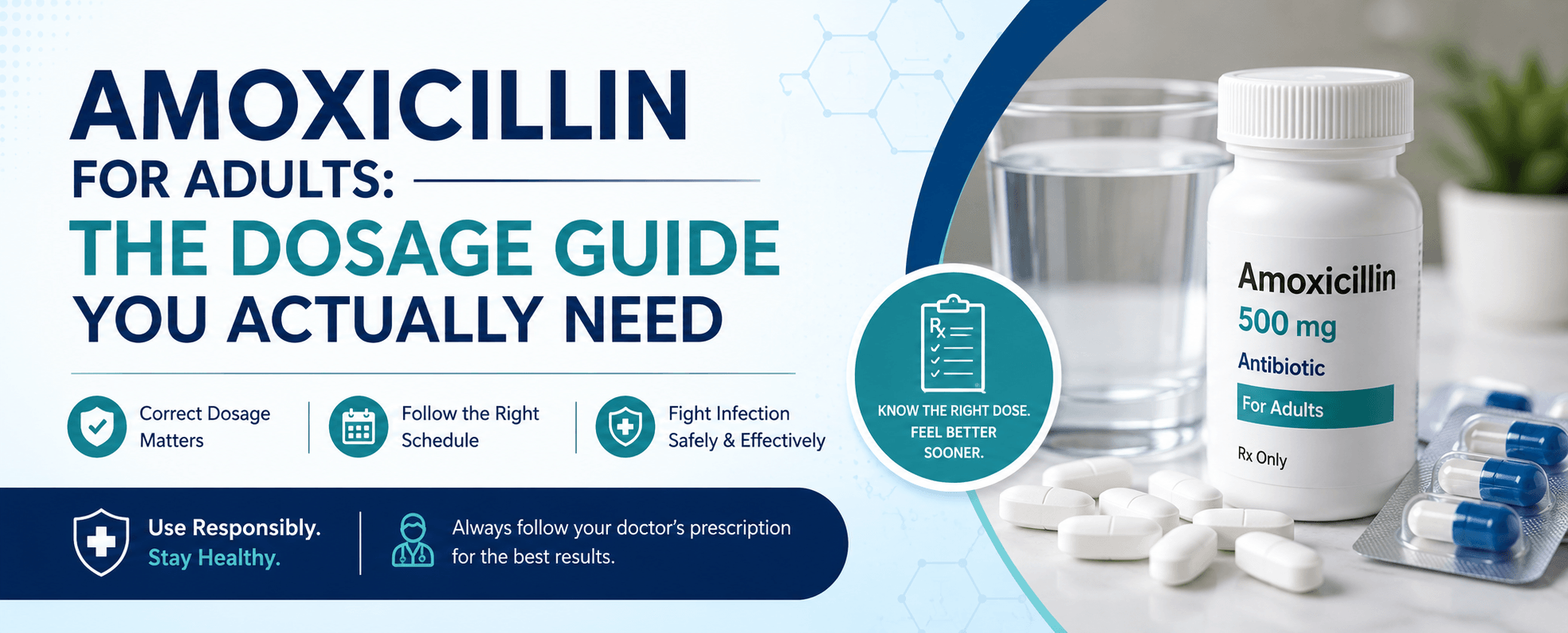
Amoxicillin for Adults: The Dosage Guide You Actually Need
Written By - Tarian Voss
on June 8, 2026
Let’s be real for a second. You’ve probably had a doctor scribble “amoxicillin” on a prescription pad at some point, handed you the slip, and sent you on your way with a quick. You must now be thinking why this medication? Why am I standing in this pharmacy?
“How much do I need? What if I miss a dose? And wait, does it matter if I take it with food?”
If that sounds familiar, you’re in the right place. This guide will help you to understand to know more about the medication Amoxicillin for Adults. Understanding the dose, conditions, safety.
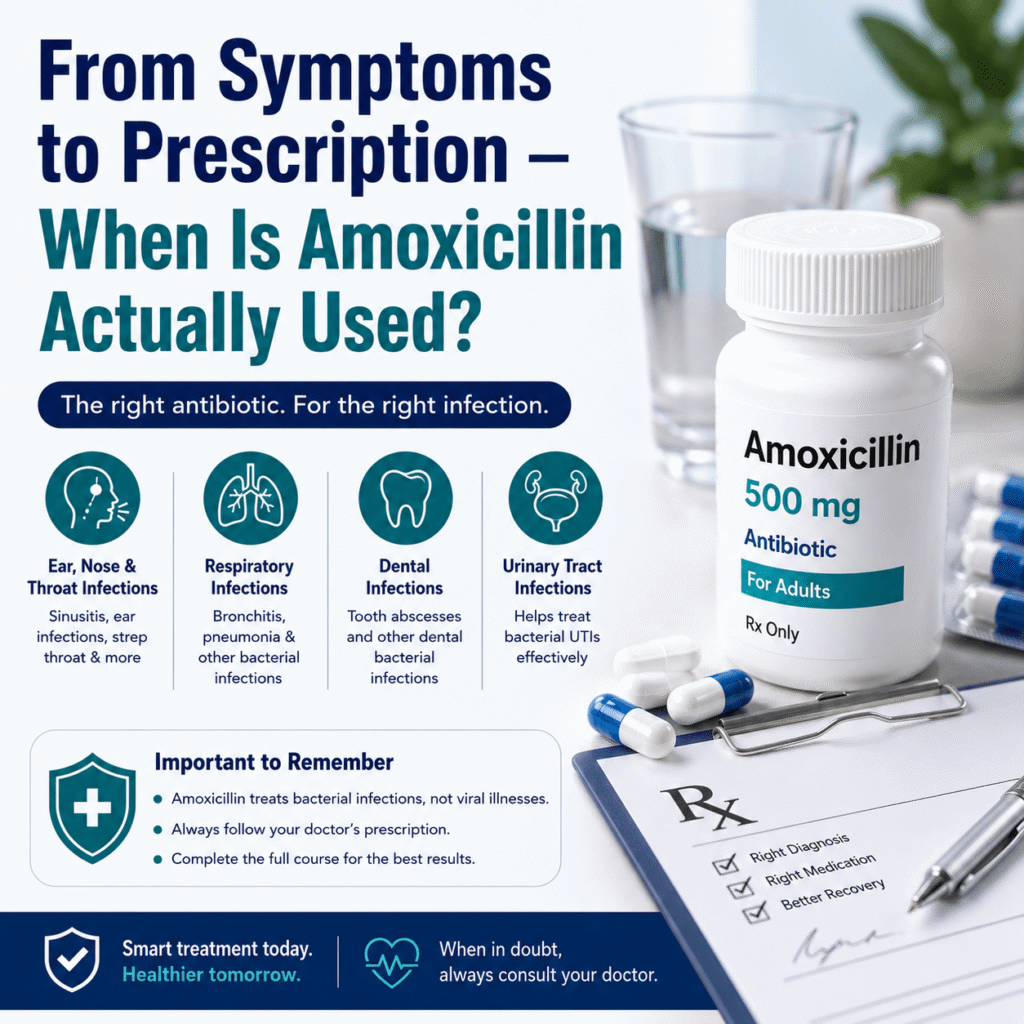
From Symptoms to Prescription — When Is Amoxicillin Actually Used?
Here is something that might surprise you: not every sore throat, runny nose, or miserable cough needs an antibiotic. In fact, most of them don’t. Yet, drugs like amoxicillin remain some of the most misunderstood and over-prescribed medications out there. Before thinking about doses, it helps to understand when amoxicillin belongs in your medicine cabinet.
Amoxicillin belongs to the family of penicillin, and it works by attacking bacteria cell walls. It weakens them until they are finish. But here is the catch: it only targets bacteria. If your illness is caused by a virus—like the common cold, the flu, or most winter coughs—amoxicillin will do absolutely nothing for you. Taking it anyway won’t speed up your recovery; it just exposes your body to unwanted side effects and helps fuel a much bigger problem: antibiotic resistance.
So, when do doctors actually reach for it? Amoxicillin is typically reserved for clear bacterial infections, such as strep throat, bacterial pneumonia, certain ear or sinus infections that refuse to clear up, and dental abscesses. Your doctor figures this out through a combination of physical exams, how long you’ve been sick, and sometimes quick lab tests like a throat swab.
The big takeaway here is that we shouldn’t pressure our doctors for an antibiotic just because we feel awful. A great clinician will only prescribe amoxicillin when there is solid evidence that bacteria, not a virus, are making you sick. If they tell you that you don’t need it, trust their judgment. Saving these powerful drugs for when they are truly necessary protects your own health and keeps the medicine working for everyone in the future. That is just smart medicine.
The Science Behind Correct Amoxicillin Dosing
Ever wonder why your doctor hands you a prescription for 500 milligrams of amoxicillin like it’s a universal formula, while your neighbor gets something completely different? It’s easy to think these numbers are just pulled off a standard chart, but there is actually a lot of behind-the-scenes math happening. Dosing antibiotics is never one-size-fits-all. It’s a careful, highly tailored balancing act designed specifically for your body.
The biggest factor is the actual bacterial battle happening inside you. A mild skin infection doesn’t need nearly as much firepower as severe pneumonia. Your doctor has to find that perfect sweet spot—giving you enough medication to completely knock out the bugs, but not so much that you end up dealing with a bunch of miserable side effects.
Then there’s your kidneys, which are truly the unsung heroes here. They do all the heavy lifting when it comes to clearing the drug from your system. If they are working a bit slower—which is incredibly common as we get older or deal with long-term health issues—the amoxicillin can pile up to risky levels. To keep things safe, your doctor will simply lower the dose or space the pills further apart.
Your age, weight, and medical history round out the rest of the equation. While kids’ doses are strictly weight-based, adult bodies still vary enough that a heavier person might need a bit more to ensure the medicine actually reaches the bloodstream effectively. Plus, as we age, our metabolism slows down, and we’re more likely to take other medications like blood thinners that complicate things. Ultimately, that little number on your bottle isn’t a random guess; it’s a personalized blueprint to get you feeling better safely.
What are the dosage and conditions?
Keep in mind, these are general ranges based on standard medical guidelines, and your personal prescription should always come directly from your healthcare provider. Self-dosing is never a good idea, no matter how Google-savvy you feel.
Pneumonia is one of the most serious infections amoxicillin treats. For community-acquired bacterial pneumonia in adults, the typical dose hovers around 500 mg to 1,000 mg taken three times daily, often for 7 to 10 days. In more severe cases, doctors may go higher or combine amoxicillin with other antibiotics for better coverage. The goal is to clear the infection completely before bacteria have a chance to regroup in your lungs.
Bronchitis gets a bit trickier because most cases are actually viral and don’t need antibiotics at all. However, if your doctor diagnoses bacterial bronchitis — usually after symptoms drag on, fevers spike, or sputum changes — amoxicillin may be prescribed at around 500 mg three times a day for 5 to 7 days. The goal is to knock out the bacterial overgrowth without unnecessary long-term exposure.
Skin infections like cellulitis or infected wounds typically respond well to amoxicillin, especially when combined with clavulanate (a common pairing). A standard dose ranges from 500 mg to 875 mg twice daily, usually for 7 to 14 days depending on severity. If redness, swelling, or pain doesn’t start improving within 48-72 hours, your doctor may switch antibiotics.
Dental abscesses are another classic amoxicillin scenario. Dentists often prescribe 500 mg every 8 hours for 3 to 7 days to control infection before or after a procedure like a root canal or extraction. But — and this is huge — antibiotics don’t replace dental treatment. The infected tooth still needs to be addressed mechanically.
Across every condition, the underlying principle is the same: hit the bacteria hard enough, for long enough, to eliminate them completely. Amoxicillin treatment duration isn’t random — it’s calculated. Trust the timeline your doctor gives you.
What Happens If the Dose Is Too Low or Too High?
This is the part most people skim over, but please don’t — because it might be the most important section in this entire guide. Dosing matters more than you think, and getting it wrong (in either direction) creates real consequences.
Let’s start with doses that are too low. When you take less amoxicillin than prescribed — whether by skipping doses, cutting capsules in half because you’re “feeling better,” or stopping the course early — you’re handing bacteria the upper hand. Here’s why: low antibiotic levels don’t kill bacteria. They just stress them. And stressed bacteria evolve. They develop resistance mechanisms that make them harder to kill next time. So that mild infection you tried to treat with half a course could come roaring back as a much tougher infection requiring stronger antibiotics. It’s like trying to put out a fire with a single cup of water — you’ve made things worse, not better.
Now let’s flip it. What about doses that are too high? More isn’t always better in medicine, and amoxicillin is a perfect example. Excessive doses can lead to a parade of unwelcome side effects: nausea, vomiting, persistent diarrhea, abdominal cramping, yeast infections, and skin rashes. In rare but serious cases, very high doses can stress your kidneys, cause crystalluria (crystals forming in urine), or trigger severe allergic reactions. None of those are fun, and most are completely avoidable by sticking to your prescribed amount.
There’s also the broader public health angle — antibiotic resistance. Every time amoxicillin is used incorrectly, somewhere in the world, bacteria are learning. They’re sharing resistance genes, evolving, and slowly making this incredible medication less effective for everyone. The CDC and WHO consider antibiotic resistance one of the top global health threats of our era. By taking your amoxicillin correctly — right dose, right timing, full course — you’re not just helping yourself. You’re helping preserve antibiotics for your kids, your parents, and future generations who’ll need them.
So please: don’t freelance with your dosing. Your prescription is a calculation, not a suggestion.
The Truth About Missed Doses and Treatment Duration
Life happens. You forget a dose between meetings. You fall asleep before taking your evening capsule. You leave the bottle at home when you head out for the weekend. So what should you actually do when you miss a dose?
If you remember a missed dose within a couple of hours, take it as soon as possible and continue with your regular schedule. If you only remember when it’s almost time for your next dose, skip the missed one entirely and just take the next scheduled one. Never double up to “catch up.” Two doses at once won’t fix anything — it’ll just spike your bloodstream with too much antibiotic and increase side effect risk.
A handy hack? Set phone alarms for each dose. Use a pill organizer if you’re forgetful. Pair doses with daily anchors like breakfast, lunch, and bedtime so they become automatic. Consistency is what keeps amoxicillin blood levels steady enough to actually fight infection effectively.
Now let’s talk about treatment duration — possibly the most misunderstood part of antibiotic therapy. Here’s the deal: when your doctor says “take this for 10 days,” they don’t mean “take it until you feel better.” Bacterial populations don’t just disappear because your symptoms fade. They get suppressed first, then slowly eliminated. If stop before that time the strongest bacteria will multiply and survive. Within days, you can find yourself sicker than before — and now with bacteria that don’t respond to amoxicillin.
This is why completing your full course is non-negotiable, even when you’re feeling fantastic on day five. That said, recent research is shifting how some doctors’ approach duration. For certain infections, shorter courses are now considered equally effective. However your doctor is the only one who can determine for the special cases.Never shorten your course on your own.
The rule is simple: take every dose, finish every course, and never save leftover antibiotics “for next time.” There shouldn’t be leftovers if you’ve completed treatment properly. Your future self will thank you.
Smart Questions to Ask Before Taking Amoxicillin
Walking into a doctor’s office can feel rushed, especially when you’re sick and just want a solution. But spending two extra minutes asking the right questions before starting any antibiotic could save you days of complications. Here’s what every adult should ask before swallowing the first dose of amoxicillin.
“Do I have a penicillin allergy?”
This is the big one. Amoxicillin belongs to the penicillin family, which means if you’ve ever reacted badly to penicillin — hives, swelling, breathing problems — amoxicillin could trigger the same response. Some reactions are mild, but others can be life-threatening (think anaphylaxis). Always remind your doctor of any past antibiotic reactions, even ones you had as a kid. Don’t assume your chart is up to date.
“Is this safe during pregnancy or breastfeeding?”
Good news: amoxicillin is generally considered one of the safer antibiotics during pregnancy and breastfeeding. But “generally” isn’t “always.” Dosing, duration, and underlying conditions still need to be reviewed carefully. If you’re pregnant, trying to conceive, or nursing, mention it upfront so your doctor can confirm amoxicillin is the right pick for you.
“Will this interact with my other medications?”
This question saves lives. Amoxicillin can interact with blood thinners like warfarin (increasing bleeding risk), certain birth control pills (potentially reducing effectiveness, though debated), methotrexate, and a few other drugs.
“Could a different antibiotic be a better fit?”
Sometimes the answer is yes. If you’ve taken amoxicillin recently, if your bacterial culture shows resistance, or if your infection is in a hard-to-reach area, your doctor might choose a different antibiotic class entirely. Asking opens the door to a more tailored treatment plan.
What side effects should I watch for, and when should I call you?
You can keep an eye for any swelling or a rash or trouble in breathing or even severe diarrhea. A good doctor will happily explain. A great one already has.
Be a curious patient. It’s not annoying. It’s smart healthcare.
Frequently Asked Questions About Amoxicillin for Adults
How long does it take to start working?
You can generally expect to start feeling a bit more human within 48 to 72 hours. Just keep in mind that “feeling better” isn’t the same thing as being cured. The smartest thing you can do is finish the entire bottle, even if you feel completely fine, to make sure the infection is totally gone.
Can I have the medication while drinking?
While a casual glass of wine or a beer won’t cause a scary medical emergency, it is honestly best to skip the alcohol until you’re done. Alcohol tends to dehydrate you, can make side effects like nausea worse, and generally slows down your body’s ability to heal up quickly.
Food or empty stomach?
You can actually take amoxicillin either way. It absorbs perfectly fine on an empty stomach, but if you notice that it makes your stomach a little queasy, taking it with a meal or a snack is an easy fix. The biggest trick is consistency—try to space your doses out evenly throughout the day.
What are the side effects that one should look for?
Most people do just fine, but the most common complaints are mild, nausea, or a skin rash, sometimes diarrhea. That said, if you develop a severe rash, persistent watery diarrhea, or anything else that just feels “off,” don’t hesitate to give your doctor a call.
Will that help with the problem of flu or the COVID-19?
Amoxicillin targets only the bacteria however the flue and COVID 19 are caused by the virus. Antibiotic only for viral illness will not work but may create side effects.
Is it safe for older adults?
Yes, but doctors usually take a closer look at the dosage for anyone over 65. Because our kidneys naturally slow down as we age, it takes a little longer for the body to clear the medication. A simple adjustment to the dose or timing keeps things perfectly safe.
What if I have a penicillin allergy?
Definitely steer clear. Amoxicillin is part of the penicillin family, so if you are truly allergic to one, your body will react to the other. Just let your provider know, and they can easily swap it for a completely different class of antibiotic.
What will happen if I stop taking the medication before the course completion?
It is incredibly tempting to quit once your energy comes back, but stopping early is a bad idea. It leaves the toughest bacteria alive, giving them a chance to multiply, mutate, and come back for round two—often making the infection much harder to treat the second time around.
Does it mess with birth control?
This is a super common worry, but the latest medical research shows that amoxicillin doesn’t actually lower the effectiveness of daily birth control pills. However, if you are stressed, dealing with stomach upset, or just want total peace of mind, using a backup method for a few days is a great backup plan.
Can I safely buy it online?
It is necessary to buy antibiotics only from the legitimate online pharmacy.
More Blogs