

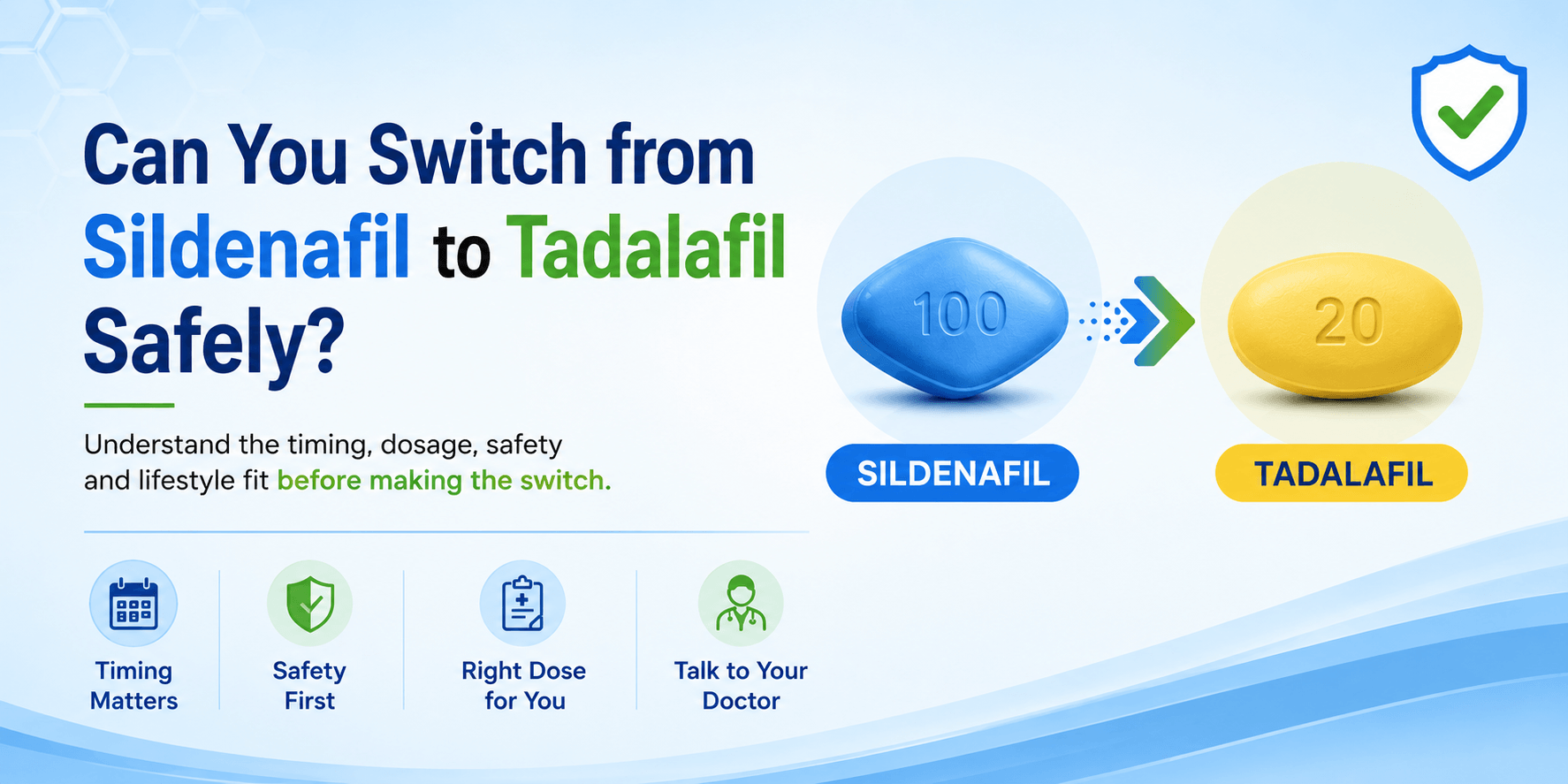
Can You Switch from Sildenafil to Tadalafil Safely?
Written By - Tarian Voss
on July 8, 2026
So, you’ve been taking the little blue pill for a while, and lately you’re wondering if there’s something that fits your life a bit better. Maybe your weekends deserve more spontaneity. Maybe you’re tired of watching the clock after dinner. Or maybe a buddy mentioned Tadalafil and you’re intrigued.
Here’s the good news: switching from Sildenafil to Tadalafil is genuinely common, medically well-understood, and — when done right — refreshingly straightforward. You’re not doing anything experimental. You’re just choosing a tool that matches your lifestyle more comfortably.
But (and there’s always a but in health writing) the switch isn’t as simple as swapping cereals at the grocery store. Timing matters. Your health history matters. Your other medications really matter. This guide walks you through everything you’d want to know before making the change — the way a friend who happens to know medicine would explain it over coffee. Let’s get into it.
Why Men Decide to Change ED Medication ?
You’d be surprised how rarely the reason is “it stopped working.” Most men who move from Sildenafil to Tadalafil do so because their life changed, not because their medication failed. And that’s a healthy way to think about ED treatment — it should mold to you, not the other way around.
The most common reason? Duration. Sildenafil gives you a solid 4–6-hour window, which sounds generous until you realize weekends don’t run on a stopwatch. Tadalafil, nicknamed the “weekend pill,” stretches its effect up to 36 hours. That’s Friday night dinner, Saturday morning coffee, and Sunday brunch — all covered by a single tablet. If you’re the spontaneous type, that mathematical advantage is hard to ignore.
Then there’s lifestyle preference. You might be tired of planning intimacy around a 30-to-60-minute onset window. Maybe you don’t want to skip that glass of red wine at dinner because it’ll delay absorption. Tadalafil handles food and moderate alcohol far more gracefully, which means fewer mental calculations and more presence in the moment.
Side effects push many men to explore alternatives too. Flushing, headaches, and that stuffy-nose feeling can show up differently on each medication. Some men tolerate Tadalafil’s muscle aches better than Sildenafil’s visual disturbances — or vice versa. Your body has an opinion, and it’s worth listening to.
Finally, there’s the deeply human factor: confidence in intimacy. Knowing your medication is already in your system — quietly working in the background — removes the ritual of “taking a pill” from the moment. For many couples, that psychological shift is more valuable than any pharmacological difference. It restores something that felt lost: the natural flow of desire meeting opportunity, without a countdown timer running in your head.
Sildenafil vs Tadalafil: What Actually Changes?
Both belong to the same drug family — PDE5 inhibitors — so mechanically, they do the same job: relax blood vessels, improve blood flow, help you respond naturally to arousal. But their personalities are wildly different, and understanding those differences is the whole point of switching thoughtfully.
Onset time is the first noticeable shift. Sildenafil usually kicks in around 30–60 minutes after you take it, and it prefers an empty (or lightly filled) stomach. Tadalafil is a bit more patient — it can start working within 30 minutes, but it doesn’t peak as sharply. Instead, it eases in and stays. You won’t feel a dramatic “switch flip.” You’ll just feel ready when the moment arrives.
Duration is where Tadalafil earns its reputation. Sildenafil clocks out around the 4-to-6-hour mark. Tadalafil sticks around for up to 36 hours — nearly six times longer. This doesn’t mean you’re aroused for a day and a half (that’s a common myth). It means your body has the capacity to respond, whenever it wants to, across that window.
Food interactions matter more than most men realize. A heavy, fatty meal can delay Sildenafil’s kick-in by an hour or more. Tadalafil doesn’t really care what you ate. You could enjoy steak, pasta, and dessert, and it would still show up on time.
Alcohol tolerance follows the same pattern — moderate drinking pairs more comfortably with Tadalafil, though excess still dulls response with either.
Finally, the daily-versus-on-demand question. Sildenafil is strictly on-demand. Tadalafil offers both: a lower daily dose (2.5 mg or 5 mg) that keeps you consistently ready, or an as-needed dose (10 mg or 20 mg) for planned occasions. Daily use suits men who value spontaneity above all. On-demand suits men who prefer control and predictability. Neither is “better” — they’re just different philosophies of the same freedom.
Can You Switch Without Taking a Break?
Short answer: usually yes, but the how matters a lot. This is where men often get confused, so let’s slow down and unpack it properly, because getting the transition right is what separates a smooth switch from an uncomfortable one.
The concept you want to understand is the washout period — the time your body needs to clear one medication before comfortably introducing another. Sildenafil has a short half-life of about 4 hours, meaning most of it exits your system within 24 hours. Tadalafil’s half-life is roughly 17.5 hours, so it lingers considerably longer. When you’re moving from Sildenafil to Tadalafil, the washout is naturally short. Doctors typically suggest waiting at least 24 hours after your last Sildenafil dose before taking Tadalafil. That gap prevents the two medications from overlapping and stacking their vasodilating effects — which could otherwise cause a sharper drop in blood pressure than your body is used to.
Timing also depends on which Tadalafil format you’re moving to. If you’re switching to on-demand 10 mg or 20 mg tablets, you’ll simply take one when needed after the 24-hour gap. If you’re moving to daily low-dose Tadalafil (2.5 mg or 5 mg), you start once the Sildenafil is fully cleared and take it at the same time every day — many men prefer mornings, so it’s active during evening intimacy.
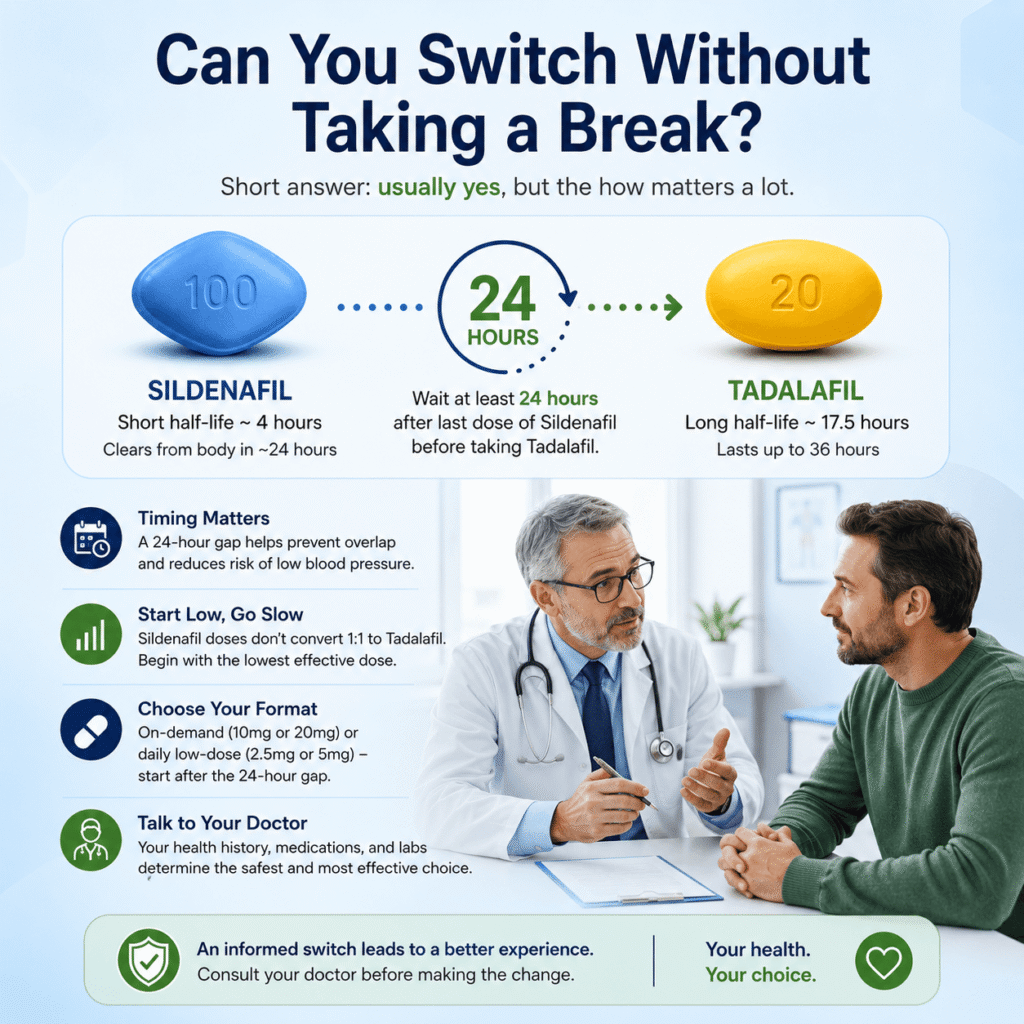
Dosage considerations are the trickiest part. Sildenafil doses (25, 50, 100 mg) don’t translate 1:1 to Tadalafil doses (2.5, 5, 10, 20 mg). A man on 50 mg Sildenafil isn’t automatically a “10 mg Tadalafil guy.” Bodies respond individually, and starting on the lower end of Tadalafil is almost always the smarter route. You can titrate up if needed.
Physician guidance is non-negotiable here — not as a legal disclaimer, but as practical wisdom. Your doctor knows your blood pressure trend, your kidney and liver function, your other prescriptions, and your cardiac history. Those factors quietly shape which dose and format suit you. A short telehealth consultation is often enough. Don’t skip it — it’s the difference between an educated switch and a hopeful guess.
Hidden Health Conditions That May Affect the Switch
ED medications don’t exist in a vacuum. Your body is a system, and PDE5 inhibitors interact with more of it than most men realize. Before you swap Sildenafil to Tadalafil, it’s worth a quiet honesty check about what else is going on inside you — because certain conditions change how your body handles either drug.
Diabetes deserves the first mention. It’s one of the most common underlying causes of ED, and it also affects circulation and nerve response. Men with diabetes often need slightly higher or more sustained dosing, and Tadalafil’s longer duration frequently suits them better — the steadier presence in the bloodstream complements a body already working harder on blood flow. But blood sugar control still matters more than the pill you choose.
Obesity changes drug distribution. Higher body fat can alter how PDE5 inhibitors metabolize, sometimes reducing effectiveness at standard doses. If your weight has shifted significantly since starting Sildenafil, that alone might explain waning results — and a switch might involve more than just a different pill.
Hypertension is where the switch demands the most caution. If you’re on blood pressure medication — especially alpha-blockers — the combination with Tadalafil can drop your pressure lower than intended. Not dangerously, if managed, but enough to make you dizzy on standing. Your doctor may adjust timing so the two medications don’t peak simultaneously.
Cardiovascular disease is the biggest red flag. If you’ve had a recent heart attack, unstable angina, or take nitrates in any form (including as-needed nitroglycerin), PDE5 inhibitors of any kind can be dangerous. This isn’t a switch issue — it’s a “should you be on these at all” issue that requires cardiology input.
Kidney function affects Tadalafil clearance more noticeably than Sildenafil. Reduced kidney function means Tadalafil stays in your system longer, so lower doses are safer. Your GFR number matters here.
Age-related changes subtly affect everything above. Men over 65 often metabolize medications more slowly, respond to lower doses, and benefit from starting conservatively. Age isn’t a barrier to switching — it’s just a reminder to titrate patiently rather than assuming your 45-year-old dose is still your baseline.
Which Lifestyle Fits Each Medication Better?
This is the section most articles skip, and it’s genuinely the most useful one. Because when it comes to ED medication, the “best” pill isn’t the strongest — it’s the one that disappears into your life without effort. Let’s match personalities to prescriptions.
Busy professionals with unpredictable schedules often thrive on Tadalafil. If your calendar is a chaotic mix of client dinners, late meetings, and rare quiet evenings with your partner, planning a Sildenafil dose an hour ahead is a mental burden. Daily low-dose Tadalafil quietly stays in the background, and you’re simply ready whenever life allows. It removes the medication from the mental foreground entirely.
Frequent travellers benefit similarly, but for different reasons. Time zones scramble digestion, sleep, and meal timing — all of which affect Sildenafil’s performance. Tadalafil, being food-agnostic and long-lasting, adapts to jet-lagged bodies better. One tablet Friday morning in Paris still works Friday night, no math required.
Weekend intimacy is Tadalafil’s specialty — hence the nickname. If you and your partner treat weekends as your re connection time, a single Friday-evening dose can support intimacy from that night through Sunday morning. There’s no re-dosing, no timing, no ritual. Just presence.
Couples planning spontaneity face an interesting paradox: “planned spontaneity” is technically an oxymoron, but every long-term couple understands the goal. You want intimacy to feel unforced without leaving it entirely to chance. Daily Tadalafil solves this beautifully — your body is quietly always capable, so desire can happen on its own timeline instead of a pharmaceutical one.
Long-distance relationships — where reunions are anticipated but the exact moment isn’t scheduled to the minute — also favour Tadalafil. You know the general window (a Saturday reunion, a weekend visit), but you don’t want to rush a pill an hour before hugging someone you’ve missed for weeks.
Sildenafil still wins for men who prefer clear, discrete dosing — those who like knowing “I took a pill, it’s working now, and it’ll be out of my system tomorrow.” It’s the medication of choice for occasional use, unpredictable partners, or men who simply prefer a defined on-off cycle. Neither approach is wrong. Only one is yours.
Smart Questions to Ask Before Switching (Your Checklist)
Before your consultation — whether it’s in-person or telehealth — bring this list with you. A prepared patient gets a better prescription. Here’s exactly what to cover so nothing gets missed.
What is your current medication intake that may interact with Tadalafil?
Ask specifically about blood pressure medications, alpha-blockers (often prescribed for prostate issues), antifungals, HIV medications, and antibiotics like erythromycin. Bring a written list — memory is unreliable when you’re already a little nervous discussing intimacy with a stranger in a white coat.
“How does moderate drinking interact with Tadalafil compared to Sildenafil?”
Tadalafil is generally more forgiving, but heavy drinking still blunts effectiveness with either drug or increases blood-pressure risks.
Is there an intake of nitrates?
This includes nitro-glycerine tablets or sprays for chest pain, isosorbide, and even some recreational substances (poppers). The combination with PDE5 inhibitors can cause dangerous blood pressure drops. This is a hard-no interaction, not a caution.
About previous side effects: “I had [headache / flushing / nasal congestion / back pain / vision changes] on Sildenafil — will Tadalafil be different?”
Side-effect profiles are different and your doctor is the person who will predict to improve. Back pain and muscle aches, for instance, are slightly more common with Tadalafil, while visual disturbances are more common with Sildenafil.
“What should I realistically expect in the first two weeks?”
Daily Tadalafil can take a few days to reach steady-state levels. On-demand Tadalafil works from the first dose but might feel subtler than Sildenafil’s sharper onset. Setting expectations prevents you from labelling a working medication a “failure” prematurely.
Shall I start on the lowest dose?
How will we know that it is the right fit? What are the lifestyle changes? It is necessary to adopt for the quality health which is sleep, exercise and stress with cardiovascular health.
Frequently Asked Questions (FAQ)
1. How long should I wait after taking Sildenafil before switching to Tadalafil?
Play it safe and wait at least 24 hours after your last Sildenafil pill before taking Tadalafil. You want to give your body enough time to fully clear out the first medication. Overlapping them can cause a sudden, dangerous drop in blood pressure, which is a headache you definitely want to avoid.
2. Is Tadalafil stronger than Sildenafil?
Not really—it’s just a marathon runner instead of a sprinter. Both do a fantastic job, but Sildenafil gives you a 4-to-6-hour window, while Tadalafil stays active in your system for up to 36 hours. It’s not about strength; it’s just about what fits your schedule better.
3. Can I take Sildenafil and Tadalafil on the same day?
Definitely not. Mixing the two won’t give you a “boost”—it just opens the door to nasty side effects like severe dizziness or a painful, prolonged erection that requires a trip to the ER. Pick one and stick with it.
4. Will my insurance cover Tadalafil if it covered Sildenafil?
It is a total roll of the dice depending on your provider. The good news? Generic Tadalafil is incredibly cheap these days. If your insurance throws a fit, just ask your pharmacist for the cash price of the generic version—you might be surprised by how affordable it actually is.
5. Does Tadalafil work better with age?
A lot of older guys prefer Tadalafil because it completely removes the pressure of having to watch the clock. However, because our metabolisms naturally slow down as we age, men over 65 usually start with a milder 5 mg or 10 mg dose to keep things smooth and safe.
6. Can I drink alcohol with Tadalafil?
You can absolutely enjoy a glass of wine or a beer at dinner. Just don’t overdo it. Heavy drinking blunts the medication’s effectiveness and makes you way more likely to feel dizzy or lightheaded. Tadalafil is a bit more forgiving with alcohol than Sildenafil, but moderation is still your best friend here.
7. What if Tadalafil doesn’t work as well for me as Sildenafil did?
Don’t panic if your first experience is a bit underwhelming. Give it two or three tries on different days before you judge it. If it’s still not hitting the mark, talk to your doctor. They can easily tweak your dose or see if something else like stress or hormone levels is getting in the way.
8. Is daily Tadalafil safe long-term?
Yes, absolutely. Millions of men take a low-dose version of Tadalafil every single day. It’s thoroughly researched, FDA-approved, and perfectly safe for long-term use, provided you keep up with your usual doctor check-ins.
9. Do I need a prescription to switch from Sildenafil to Tadalafil?
Yes. Because these medications interact with your blood pressure, a doctor still needs to sign off on the switch. Fortunately, it’s usually as simple as a quick five-minute telehealth text or call to get your prescription updated.
10. Will switching to Tadalafil affect my libido or desire?
No. These pills only handle the physical mechanics of blood flow—they don’t change how you feel mentally. If you feel like your actual sex drive has taken a dip, that’s a separate conversation to have with your doctor, as it’s usually tied to hormones, fatigue, or stress.
More Blogs