

The Midnight Snacking Epidemic & Orlistat Guide
Written By - Cade Harrington
on May 25, 2026
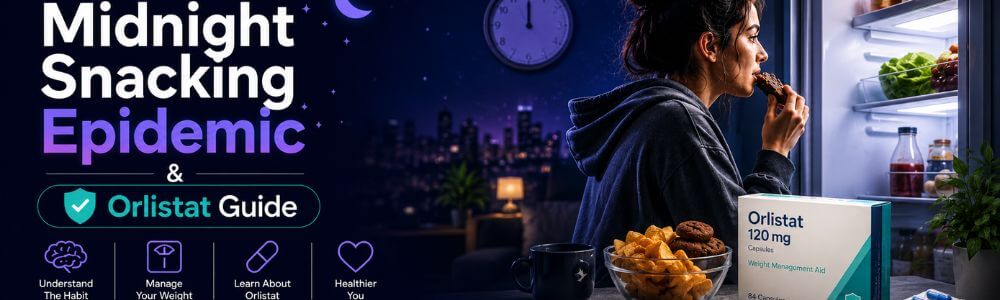
The Midnight Snacking Epidemic & Orlistat Guide: Why Your 2 AM Fridge Raids Are Sabotaging Your Waistline (And What Actually Helps)
Introduction: The 1 AM Confession Nobody Talks About
You’ve been there. The house is quiet, your phone screen glows softly, and suddenly — without quite knowing how — you’re standing in front of the open fridge at 1:14 AM, contemplating last night’s leftover pizza like it owes you money. If this scene feels suspiciously familiar, congratulations: you’re part of what behavioral researchers are now calling the midnight snacking epidemic — a quietly growing modern health crisis that’s quietly expanding waistlines across the globe.
Here’s the thing nobody tells you: late-night eating isn’t a character flaw. It’s not laziness, lack of willpower, or proof that you’re “bad at dieting.” It’s a beautifully complex cocktail of hormones, sleep debt, screen-induced dopamine spikes, and stress chemistry — all conspiring against your best intentions the moment the sun goes down. And when willpower alone stops working (which it usually does around day four of any diet), modern medicine offers a helping hand worth understanding.
That’s where this guide comes in. You’ll learn why your brain practically demands salty-sweet snacks after 10 PM, how poor sleep quietly inflates your belly fat, and where medications like Orlistat fit into a smarter, kinder approach to weight management. We’ll keep things light, science-backed, and refreshingly judgment-free. No shame, no scare tactics — just real talk about what’s happening in your body and what you can actually do about it. Whether you’re researching an orlistat online informational guide out of curiosity or you’ve been quietly searching “obesity help” at 3 AM (no judgment, we’ve all been there), this post is built for you. Let’s dig in.
Why Late-Night Cravings Feel Impossible to Control ?
Let’s settle something right now: those 11 PM cravings aren’t in your head — they’re in your hormones, your habits, and your half-charged nervous system. When evening rolls around, your body undergoes a fascinating biochemical shift. Ghrelin, your hunger hormone, often spikes in the late evening if you’ve been under-eating or stressed during the day, while leptin (the hormone that signals fullness) drops if you’re sleep-deprived. The result? Your brain genuinely believes you’re starving, even when you ate dinner three hours ago. It’s not weakness — it’s biology playing a slightly cruel joke on you.
Then there’s dopamine, the sneaky little neurotransmitter behind every “just one more chip” moment. Late-night snacking activates the same reward circuitry as scrolling social media or binge-watching your comfort show. Your brain learns the pattern fast: couch + Netflix + crunchy snack = pleasure. Repeat this for two weeks, and you’ve built what neuroscientists call a dopamine habit loop — a craving that fires automatically the second you sit down at night, whether you’re actually hungry or not. You’re not failing; you’re being remarkably consistent at training your brain to expect food at bedtime.
Stress amplifies everything. Cortisol — your stress hormone — drives you toward calorie-dense, high-fat, high-sugar foods because evolutionarily, your body assumes stress means famine is coming. Add poor sleep into the mix and your prefrontal cortex (the rational decision-maker) literally loses processing power, while your amygdala (the impulsive, emotional part) takes the wheel. That’s why a tired you eats cookies your well-rested self would politely decline. Understanding this isn’t an excuse — it’s ammunition. Once you know why your brain demands snacks at midnight, you can start interrupting the pattern with strategy instead of shame. And that’s the first real step toward genuine obesity help that lasts.
Could Your Sleep Schedule Be Increasing Belly Fat?
Short answer: yes, and the science is genuinely uncomfortable to read. Long answer? Your sleep schedule might be doing more damage to your waistline than that occasional cheat meal you keep apologising for. When you consistently sleep fewer than seven hours, your body enters a low-grade stress state. Cortisol levels stay elevated overnight, which directly encourages your body to store fat — specifically the visceral kind, the stubborn belly fat that wraps around your organs and refuses to leave no matter how many crunches you do. It’s not just unflattering; visceral fat is metabolically active and linked to insulin resistance, inflammation, and cardiovascular risk.
Then there’s your circadian rhythm, the internal 24-hour clock that governs everything from hormone release to metabolism. When you eat at irregular hours — say, a heavy meal at midnight — your body processes those calories far less efficiently than it would at noon. Research shows that the same meal consumed late at night produces higher blood sugar spikes, more fat storage, and worse next-day appetite control compared to eating it earlier. Your liver, pancreas, and gut basically clock out at sunset, and forcing them to process a burrito at 1 AM is like asking your accountant to do your taxes during their vacation. Possible? Sure. Quality work? Absolutely not.
Sleep deprivation also slows your resting metabolic rate by up to 5–8% — which doesn’t sound dramatic until you realize that’s roughly 100–150 calories per day your body simply stops burning. Multiply that across a year and you’ve got a quiet five-to-ten-pound weight creep, no extra eating required. Worse, tired people move less without realizing it: fewer steps, less fidgeting, lower NEAT (non-exercise activity thermogenesis). So if you’ve been doing everything “right” but the scale won’t budge, your bedtime might be the real saboteur. Fix your sleep, and you’ve already done half the work of any weight loss medication online strategy. The other half? Well, that’s where smart pairing comes in.
How Does Orlistat Support Smart Fat Management?
Orlistat — sold under brand names like Xenical and Alli — is a lipase inhibitor, which is a fancy way of saying it blocks the enzyme that breaks down dietary fat in your gut. In plain English: when you take Orlistat with a meal that contains fat, roughly 25–30% of that fat passes right through your digestive system unabsorbed, exiting through the usual exits. You eat the fat, but you don’t fully absorb the calories. It’s one of the few FDA-approved weight loss medications with decades of clinical evidence behind it, which is why doctors still trust it for long-term obesity management.
What makes Orlistat genuinely interesting isn’t just the mechanism — it’s the behavioral feedback loop it creates. Because the medication works by blocking fat absorption, eating a particularly greasy meal often produces… let’s call them “noticeable digestive consequences.” That sounds unpleasant, and frankly it can be, but here’s the upside: it gently retrains your eating habits. You start instinctively reaching for grilled chicken instead of fried wings, baked instead of buttery, lean instead of loaded. Orlistat doesn’t just block fat — it teaches your brain to prefer lower-fat choices. Think of it as a slightly stern but well-meaning dietary coach living inside your gut.
Clinical studies show that combined with modest dietary changes and light exercise, Orlistat users typically lose 5–10% of their body weight within six months — and more importantly, they tend to keep it off longer than those relying on willpower alone. It’s not magic, and it’s not a shortcut. It’s a tool. For people dealing with stubborn weight, prediabetes, or BMI-related health risks, this kind of medical support can be the bridge between “trying” and actually getting somewhere. If you’re researching an orlistat online informational guide, the most honest takeaway is this: medications work best when they’re part of a bigger plan — and Orlistat happens to be one of the best-studied bridges available.
Learn about the New Weight Revolution Beyond GLP1
The Psychology Behind Emotional Eating Patterns
Here’s confession nutritionists rarely admit out loud: most overeating has almost nothing to do with hunger. You eat because you’re bored. You eat because you’re anxious. You eat because the spreadsheet broke at 4:47 PM and food is the fastest, cheapest, most legal dopamine hit available. Emotional eating is the psychological backbone of the midnight snacking epidemic, and pretending otherwise is why so many diets quietly collapse after week three. Your relationship with food is also your relationship with stress, loneliness, exhaustion, and unmet emotional needs — and no meal plan in the world can out-discipline a feelings-shaped hole.
Comfort foods are wired deep into your memory. That mac and cheese isn’t just cheese and pasta — it’s your grandmother’s kitchen, a Sunday in 2008, the safety of a childhood you didn’t fully appreciate at the time. Neuroscientists have shown that familiar high-carb, high-fat foods activate the brain’s nostalgia and reward centers simultaneously, which is why nobody ever stress-eats a kale salad. When you’re feeling low, your brain doesn’t crave nutrition — it craves regulation. Food becomes a self-soothing tool, and over time, an emotional reflex.
Then there’s the modern villain: digital overstimulation. Endless scrolling, constant notifications, and blue-light exposure keep your nervous system in a low-grade “on” state, suppressing the natural wind-down signals that should be telling you to sleep, not snack. Boredom snacking has practically been replaced by stimulation snacking — eating while watching, scrolling, working, gaming. You’re not even bored anymore, you’re just chronically overstimulated and slightly dysregulated. Breaking this pattern doesn’t require iron willpower; it requires awareness, gentler routines, and sometimes external support. Whether that support looks like therapy, mindful eating practices, better sleep hygiene, or a medical tool like Orlistat — there’s no wrong door. The wrong move is pretending you can shame yourself into wellness. That’s never worked. It never will.
Buying Orlistat Online: What Trusted Pharmacies Do Differently ?
Let’s be honest — buying any medication online can feel a little like ordering sushi from a gas station. Some places are genuinely excellent; others, less so. When it comes to Orlistat online, the difference between a trusted pharmacy and a sketchy one isn’t just about price — it’s about authenticity, safety, and whether the pills you’re swallowing are actually what they claim to be. The global market is unfortunately flooded with counterfeit weight loss medications, some containing wrong dosages, mystery fillers, or zero active ingredient at all. A genuine pharmacy isn’t shy about proving its legitimacy; a fake one hopes you won’t ask.
So what do trusted online pharmacies actually do differently? First, they require a valid prescription or offer a verified online consultation with a licensed healthcare professional. If a website sells you prescription-grade Orlistat with no questions asked, that’s not convenience — that’s a red flag wearing a trench coat. Reputable platforms verify your medical eligibility, ask about existing medications, and flag potential interactions (Orlistat can interfere with fat-soluble vitamins A, D, E, K, and certain medications like cyclosporine and levothyroxine). Second, they source medication from licensed manufacturers with traceable batch numbers, intact tamper-evident packaging, and authentic holograms — not loose blister packs in an unmarked envelope.
Third, and this is the underrated one: transparent customer support. A trustworthy pharmacy publishes its physical address, pharmacist credentials, regulatory licenses, and a real phone number staffed by humans who can answer questions about dosing, side effects, and timing. At GenPharmaRx, for example, every order is dispatched through verified channels, with discreet packaging and pharmacist-reviewed prescriptions — because your privacy and your safety shouldn’t be optional add-ons. When you’re shopping for weight loss medication online, the cheapest deal isn’t always the smartest one. Pay slightly more, sleep significantly better. Your gut — quite literally, in Orlistat’s case — will thank you. If something feels off about a website, trust your instinct and click away. There are reliable options. You just must know what to look for.
The Weight Loss Future – Medicine + Lifestyle
The future prediction not only depends on the pills or only the lifestyle. Oversimplification in ending in this era and is replaced by the smarter and the compassionate model that will acknowledge the psychology and modern living. There are some emerging wellness’s that trend and are increasing the blending nutritional science with sleep optimization and movement therapy, also the targeted medications such as Orlistat. It’s no longer “diet vs. drug” — it’s both, calibrated to your specific body and lifestyle.
You’re already seeing this shift in 2026. Continuous glucose monitors on non-diabetic users, AI-powered meal planning apps, sleep-tracking rings whispering sweet metabolic data into your wrist, and telehealth consultations that prescribe medication alongside therapy — all of it points to a more personalized, data-driven approach. Orlistat fits beautifully into this ecosystem because it’s predictable, well-studied, and behavioral educational. Pair it with circadian-friendly eating windows (most of your calories before 7 PM), strength training twice a week, and seven consistent hours of sleep, and you’ve built something far more powerful than any single intervention could achieve alone.
The mindset shift matters too. The future isn’t about punishing yourself thinner — it’s about supporting yourself healthier. Weight loss medication used to carry stigma, like it was the “cheater’s path.” That narrative is finally dying, and good riddance. We don’t shame people for using glasses when their eyes need help, or insulin when their pancreas needs help. Why should we shame anyone for using a clinically proven tool when their metabolism needs help? If you’ve been quietly carrying that guilt, give yourself permission to put it down. Combining medical support with lifestyle changes isn’t taking a shortcut — it’s taking the smart road. Your future self, the one with steadier energy, better sleep, and a kinder relationship with the bathroom scale, is already cheering you on. Meet them halfway.
FAQS
Is it ok to take Orlistat every day?
Yes, it really is. Orlistat is thoroughly approved for daily, long-term use—often for up to a year or two under medical supervision. The reason it has such a strong safety track record is simple: it does its work locally, right inside your gut. Because it isn’t heavily absorbed into your bloodstream, it bypasses many of the systemic risks and side effects that come with other weight-loss medications. Just keep your doctor or pharmacist in the loop so they can monitor your progress.
What type of the results are with Orlistat?
We all want fast results, but patience is your best friend here. You will likely notice the initial shifts on the scale within your first two to four weeks. However, real, meaningful progress—the kind where you lose about 5% to 10% of your starting body weight—typically shows up around the three-to-six-month mark. This medication isn’t a overnight miracle worker; it works hand-in-hand with a lower-fat diet and a bit of daily movement.
Can I buy Orlistat online without a prescription?
It depends entirely on the strength you need. The lower-dose version (60mg, which you probably know as Alli) is available right over the counter in many countries. However, the prescription-strength version (120mg) requires a proper medical consultation.
If you want to shop online you may consider the platforms such as GenPharmarx or offer verified digital sessions.
What are the foods that you need to avoid while taking Orlistat?
To put it bluntly: you will want to step away from heavy, greasy, or deeply fried foods. Try to steer clear of meals where more than 30% of the calories come from fat. A good rule of thumb is to aim for less than 15 grams of fat per meal. Focus on grilled, baked, or steamed dishes instead. If you do treat yourself to a high-fat meal while taking Orlistat, your digestive system will quickly and uncomfortably let you know it is unhappy.
Does Orlistat help with belly fat specifically?
While Orlistat isn’t a spot-reduction tool—meaning you can’t tell it exactly where to burn the fat—visceral (belly) fat is usually the first to budge when your body starts dropping weight. When you pair the medication with decent sleep and a modest calorie deficit, that stubborn abdominal fat tends to respond incredibly well.
Can stress and poor sleep really cause weight gain?
They absolutely can. When you are chronically stressed or running on empty, your body pumps out cortisol. This hormone loves to store fat right around your midsection. To make things worse, sleep deprivation spikes ghrelin (the hormone that makes you hungry) and tanks leptin (the hormone that tells you you’re full). It is a frustrating hormonal triple-threat that drives weight gain, even if you feel like you aren’t overeating.
Is midnight snacking worse than daytime snacking?
Unfortunately, yes, late night eating is very much tough on your body. Sneaking snacks close to bedtime disrupts your natural circadian rhythm, spikes your blood sugar more sharply, and signals your metabolism to store fat rather than burn it. What you eat is incredibly important, but when you eat matters almost as much.
Can I combine Orlistat with intermittent fasting?
Many people do this very successfully. The golden rule here is all about timing: you should only take your Orlistat capsule alongside a meal that contains some fat within your eating window. If you are skipping a meal or eating a completely fat-free snack to break your fast, you can simply skip that dose of Orlistat.
Are there any side effects? What are they?
Most side effects are strictly digestive—think oily stools, extra gas, and sudden, urgent trips to the bathroom. The good news is that you have a lot of control over this. These symptoms are usually just a direct reaction to eating too much fat. As you adjust your meals, the side effects typically fade away. Because Orlistat blocks fat absorption, it can also limit your intake of fat-soluble vitamins, which is why taking a daily multivitamin at bedtime is highly recommended.
More Blogs